Exit liquidity: who buys your unit when you want out
Tu Anh Nguyen (Ann) · 26 October 2026 · 3 min read
Foreign buyers in fast-growing markets tend to spend their diligence on the entry and almost none on the exit. In Vietnam that is the wrong allocation, because the entry is comparatively easy and the exit is where the structural constraints bite.
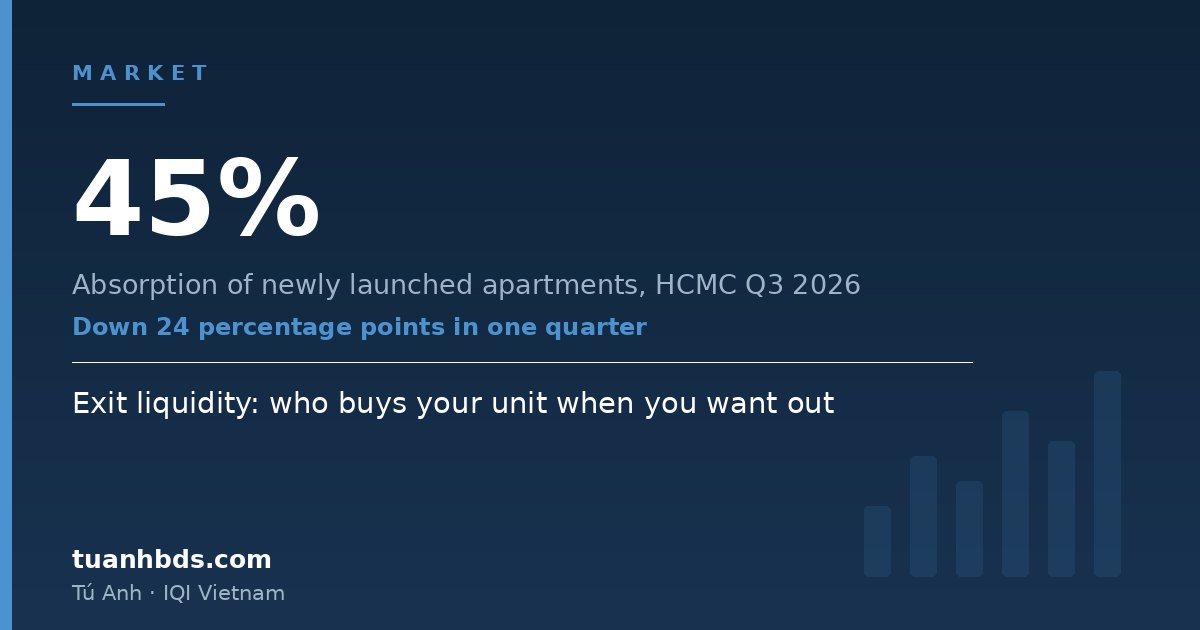
- Absorption of newly launched apartments, Ho Chi Minh City: 45%, down 24 percentage points in the quarter
- Absorption across the first nine months: 43% (Hanoi: 67%)
- Secondary apartment prices: around VND 60 million/m², easing about 4% in the quarter
- Grade A pipeline 2026–2029: around 6,627 units, over 60% in the east
The question to ask before you buy
Not "will this go up?" but:
"In five to seven years, who specifically is the person who buys this unit from me, and what else will they be choosing between?"
If that person cannot be described — their nationality, their budget, why this building rather than the three next to it — then the exit has not been thought through.
Who you will be competing with
Most foreign sellers assume their competition is other individual owners. Usually it is the developer.
In a market with Q3 absorption at 45%, developers are carrying unsold stock. When you list, a buyer looking at your unit is also looking at new units in the same or a neighbouring project, where the developer can offer:
- interest rate subsidies during the early period
- extended payment schedules across construction
- furniture packages and fee waivers
- a new unit with full warranty, rather than a resale
You can offer none of these. Your only lever is price.
This is the strongest argument for buying well rather than buying early. The discount you negotiate at entry is the buffer that protects you at exit, because at exit you will be the one negotiating from the weaker side.
The pipeline matters more than the current quarter
Current weakness is cyclical. The supply pipeline is structural.
Savills expects around 6,627 new Grade A apartments in Ho Chi Minh City between 2026 and 2029, with more than 60% of future Grade A supply in the eastern area including Thu Thiem.
For a buyer of a Grade A unit in the east today, that is the competitive set you will be selling against in five years — and much of it will be newer than yours.
This does not argue against buying in the east, where the infrastructure case is real. It argues for being specific about what distinguishes your unit from the several thousand that will follow it.
Divergence is widening
An important nuance in the Q3 2026 data: CBRE recorded the secondary price adjustment as broad-based, but with increasingly pronounced divergence between projects.
That is the signal to act on. The market average tells you very little; what matters is which side of the divergence your building sits on. The factors that separate them:
- Delivered build quality and the actual state of the building, not the renderings
- Competence of building management, visible on a site visit
- Genuine occupancy, not units held empty by investors
- How much unsold stock the developer still holds in the same project
The domestic buyer is your real market
The foreign buyer pool is capped by design: 30% of a building, 250 landed houses per ward-sized area. It is small and it has its own constraints, including a depleting ownership term.
The domestic pool is the market, and domestic buyers hold housing on a stable long-term basis — they are not pricing a 50-year clock.
Which leads to a practical filter at purchase:
Would a Vietnamese family or a Vietnamese investor want this unit at a price that works for me?
If the honest answer is no — if the unit only makes sense to an expatriate buyer at an expatriate price — the exit is thinner than the brochure suggests, regardless of how good the location is.
In a market where absorption has fallen 24 percentage points in one quarter, a seller who needs to transact quickly has very little leverage. The right response is not to avoid Vietnam; it is to enter only with capital that can stay still for five years or more, and to buy at a price that does not require a rising market to work.
Frequently asked questions
How liquid is the Vietnamese resale market right now?
Weak. Absorption of newly launched apartments in Ho Chi Minh City was 45% in Q3 2026, down 24 percentage points quarter on quarter, and 43% across the first nine months. Secondary prices eased about 4% in the quarter to around VND 60 million per square metre.
Who competes with me when I sell?
Primarily developers who still hold unsold stock in the same or nearby projects. They can offer interest subsidies, extended payment schedules and furniture packages. An individual seller cannot, which usually leaves price as the only lever.
How much new Grade A supply is coming?
Savills expects around 6,627 new Grade A apartments in Ho Chi Minh City over 2026 to 2029, with more than 60% of future Grade A supply located in the eastern area including Thu Thiem.
Does the 50-year term hurt resale?
It applies pressure gradually rather than at expiry. The practical mitigation is that the deepest buyer pool in Vietnam is domestic, and domestic buyers hold housing on a stable long-term basis — so a unit that appeals to local buyers has a materially better exit.
What improves exit liquidity most?
Buying a unit that domestic buyers want: sensible layout, credible building management, a location that works for local work and schooling, and a price that stands up against domestic comparables rather than against what other foreign buyers paid.
Sources
- CBRE Vietnam — absorption and secondary pricing, Q3 2026 — diendandoanhnghiep.vn
- CBRE Vietnam — divergence between projects on the secondary market — nhipsongkinhdoanh.vn
- Savills Vietnam — Grade A supply pipeline 2026–2029 — tienphong.vn
- Analysis of absorption across Hanoi and Ho Chi Minh City, Q3 2026 — baomoi.com
I am Tu Anh Nguyen (Ann), a real estate consultant at IQI Vietnam in Ho Chi Minh City. Before this I spent nearly eight years in Kuala Lumpur and moved home six times there — so I have been the foreigner trying to read someone else's property market, in someone else's language.
What that means in practice: I will put the awkward answers in writing. Remaining foreign quota in a specific building, the Department of Construction eligibility letter, the bank guarantee, the real walking distance to a metro station, what a unit like yours actually resold for. If a deal does not stand up, I would rather tell you before you wire a deposit.
Figures in this article come from published research and official documents, listed under Sources. This is general information for research purposes, not legal, tax or investment advice. Vietnamese property law is applied case by case — have a Vietnam-qualified lawyer review your specific transaction. Last updated: 26 October 2026.

Real estate consultant at IQI Vietnam, Ho Chi Minh City. Nearly eight years living and working in Kuala Lumpur before returning to Vietnam. Works in English and Vietnamese.
About Ann →