Vietnam residential market snapshot, Q3 2026
Tu Anh Nguyen (Ann) · 26 October 2026 · 3 min read
A short, source-cited read of where the Vietnamese residential market actually sits — written for someone deciding whether to allocate capital, not for someone who needs reassurance.
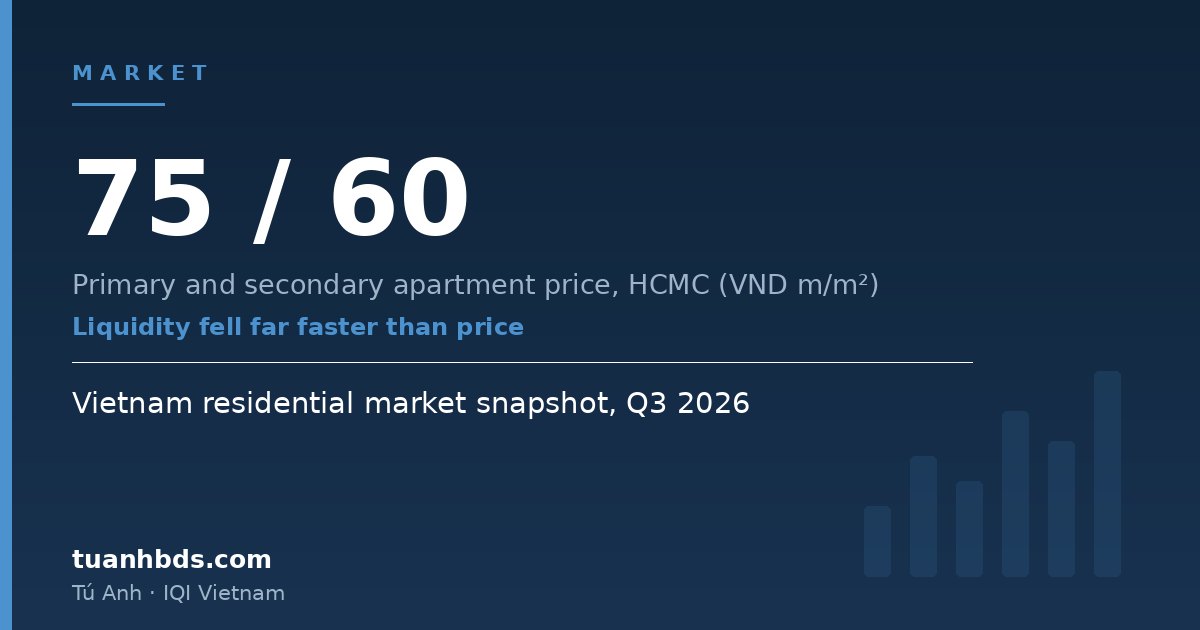
- Primary price: ~VND 75 million/m² net usable area, down 2.3% q/q
- Primary price, central area: ~VND 104 million/m², up 10% y/y
- Secondary price: ~VND 60 million/m², down about 4% q/q
- New launches: 3,267 apartments, down 53% y/y
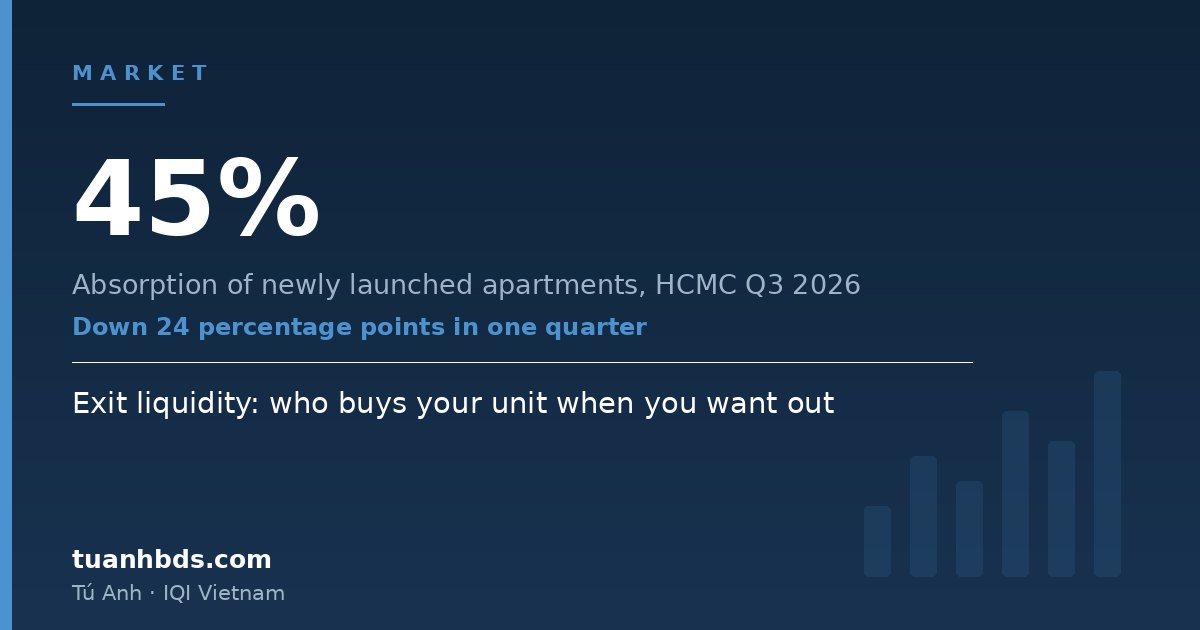
- Absorption of new supply: 45%, down 24 percentage points q/q
The defining feature: liquidity fell much faster than price
This is the single most important thing to understand about Vietnam right now.
Absorption of newly launched apartments dropped 24 percentage points in one quarter, to 45%. Over nine months, absorption against total existing primary supply was 43% in Ho Chi Minh City and 67% in Hanoi.
Primary prices, meanwhile, fell only 2.3%.
Three reasons for that gap:
Developers postponed instead of discounting. More than 40% of supply planned for Q3 launch was deferred. Cutting a published price resets the value of every subsequent phase and antagonises earlier buyers; postponing is strategically cheaper.
Input costs did not fall. The new land price framework applied from 1 January 2026 raised land cost for projects, and funding costs stayed high.
Product mix anchors the average. Grade A and Grade B accounted for roughly 80% of new launches, so the average price reflects what is being built rather than what buyers can afford.
Weak absorption transfers negotiating power to the buyer — time to inspect, no pressure to decide, and real choice within a price band. It also warns that when you come to sell, conditions may look similar. Both readings are correct and should be held together.
Hanoi and Ho Chi Minh City are out of phase
| Indicator, Q3 2026 | Hanoi | Ho Chi Minh City |
|---|---|---|
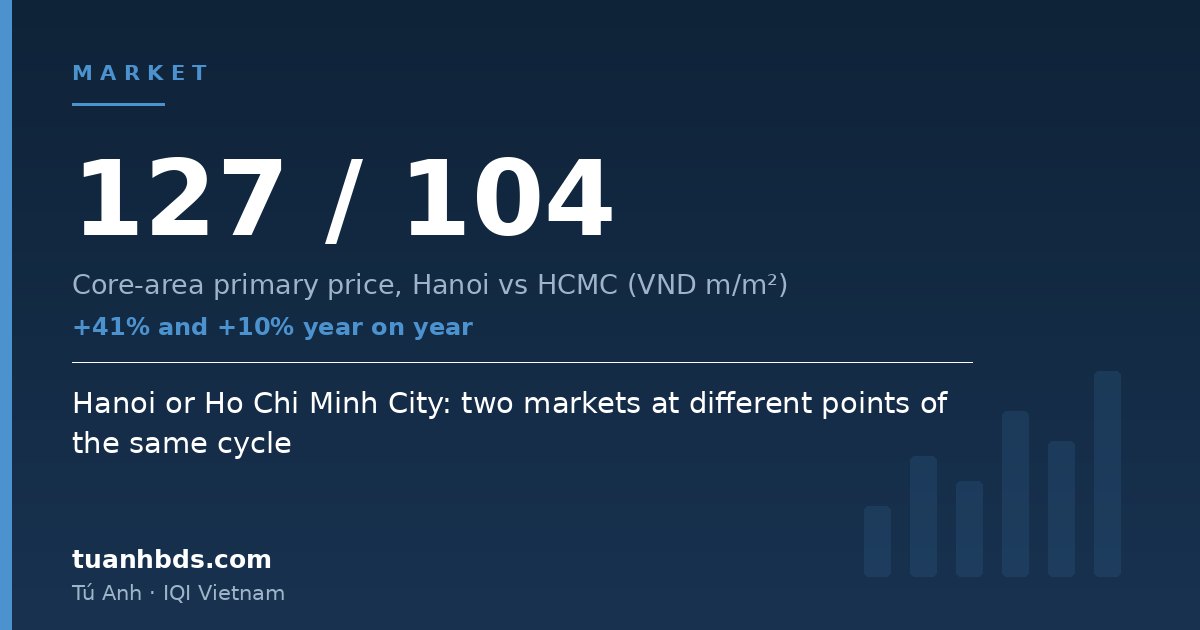
| Core-area primary price | ~VND 127m/m², +41% y/y | ~VND 104m/m², +10% y/y |
| Nine-month absorption | 67% | 43% |
| Secondary price | falling for three consecutive quarters | just beginning to ease |
| New supply | ~6,200 units, −40% y/y | 3,267 units, −53% y/y |
| Structural issue | shortage of affordable stock | supply shifting outside the core |
Hanoi ran through a sharp price increase and entered correction earlier; secondary prices there have been falling since Q1 2026. Ho Chi Minh City rose more modestly and is only now beginning to adjust.
Hanoi's structural problem is severe: Grade C apartments are down to about 4% of primary supply, having fallen an average of 27% a year since 2022. More than 70% of units transacted in the quarter were priced above VND 6 billion.
Read the Ho Chi Minh City average carefully
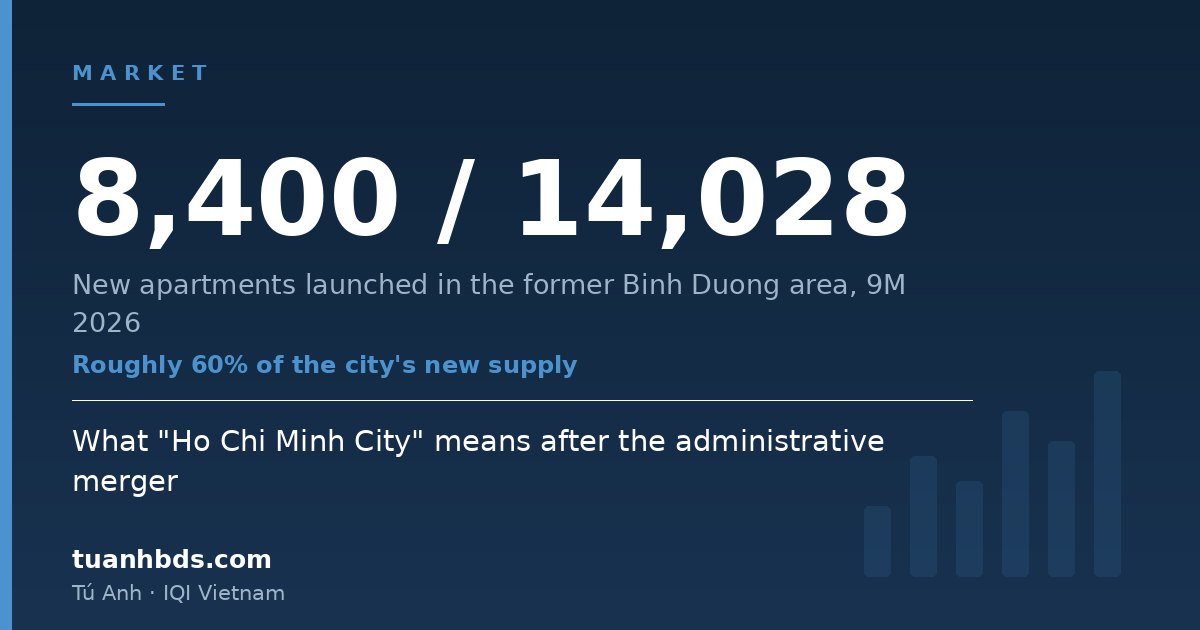
After the administrative merger, "Ho Chi Minh City" covers a far larger area. In the first nine months of 2026 the market recorded 14,028 new apartment launches, of which more than 8,400 were in the formerly separate Binh Duong area.
So the city-wide average of VND 75 million/m² blends two quite different markets. The central area was around VND 104 million/m² and rising 10% year on year over the same period.
Any analysis using the city-wide average to assess a central-district project is using the wrong number.
The economy is not the problem
This is where many international readers misdiagnose Vietnam.
- Ho Chi Minh City GRDP: +9.06% over nine months, +9.86% in Q3 alone
- Nationwide property transactions in Q3: about 92,000, at 92% of Q2
- Leasing: office occupancy close to 90%, retail 92%, serviced apartments 85%
Capital is not absent and demand to use property is solid. What is missing is alignment between asking prices and what owner-occupiers can pay at current borrowing costs — a gap that has widened for two years.
What to watch next
Three indicators, in the order they usually move:
- Does discounting become explicit? When developers cut published prices rather than offering furniture and interest subsidies, primary pricing is genuinely adjusting.
- Does the secondary price fall for a second consecutive quarter? One quarter is noise; two is a trend. Hanoi is already at three.
- Do mortgage rates ease? The fastest-acting variable on real demand — and currently constrained by the requirement that real estate credit growth not exceed overall credit growth at each bank.
Savills expects around 6,000 apartments to launch in Q4 2026, nearly 30% below the original forecast.
This page is updated when each quarter's data is published, at the same address, so it stays usable as a reference rather than becoming a dated news item.
Frequently asked questions
What are the headline numbers for Ho Chi Minh City in Q3 2026?
Primary apartment prices averaged around VND 75 million per square metre of net usable area, secondary around VND 60 million. New launches totalled 3,267 apartments, down 53% year on year, and absorption of newly launched supply was 45%.
Why do CBRE and Savills report different figures?
They measure different baskets of projects. CBRE recorded 3,267 new apartment launches in Ho Chi Minh City in Q3 2026 while Savills recorded about 1,900, with total primary supply of 5,800. The difference largely reflects whether projects in the formerly separate Binh Duong and Ba Ria–Vung Tau areas are included after the administrative merger.
Is the Vietnamese economy weak?
No. Ho Chi Minh City GRDP grew 9.06% over the first nine months of 2026, and 9.86% in Q3 alone. Around 92,000 property transactions completed nationwide in Q3. The constraint is affordability and credit cost, not economic activity.
Why did liquidity fall faster than prices?
Developers chose to postpone launches rather than cut prices, with more than 40% of planned Q3 supply deferred. Input costs also did not fall, given the new land price framework and high funding costs. So absorption dropped 24 percentage points while primary prices fell only 2.3%.
What is expected in Q4 2026?
Savills expects around 6,000 apartments to launch, nearly 30% below the original forecast, as some projects continue to delay.
Sources
- CBRE Vietnam — Ho Chi Minh City housing market, Q3 2026 — diendandoanhnghiep.vn
- CBRE Vietnam — prices and cumulative supply (CafeLand) — cafeland.vn
- Savills Vietnam — Ho Chi Minh City market overview, Q3 2026 — nhipsongnhadat.vn
- CBRE Vietnam — Hanoi apartment market, Q3 2026 — doanhnhan.baophapluat.vn
- HoREA and Ministry of Construction — Q3 2026 transactions — batdongsan.baoxaydung.vn
I am Tu Anh Nguyen (Ann), a real estate consultant at IQI Vietnam in Ho Chi Minh City. Before this I spent nearly eight years in Kuala Lumpur and moved home six times there — so I have been the foreigner trying to read someone else's property market, in someone else's language.
What that means in practice: I will put the awkward answers in writing. Remaining foreign quota in a specific building, the Department of Construction eligibility letter, the bank guarantee, the real walking distance to a metro station, what a unit like yours actually resold for. If a deal does not stand up, I would rather tell you before you wire a deposit.
Figures in this article come from published research and official documents, listed under Sources. This is general information for research purposes, not legal, tax or investment advice. Vietnamese property law is applied case by case — have a Vietnam-qualified lawyer review your specific transaction. Last updated: 26 October 2026.

Real estate consultant at IQI Vietnam, Ho Chi Minh City. Nearly eight years living and working in Kuala Lumpur before returning to Vietnam. Works in English and Vietnamese.
About Ann →