What "Ho Chi Minh City" means after the administrative merger
Tu Anh Nguyen (Ann) · 26 October 2026 · 3 min read
If you read a Vietnamese market report written before 2026 alongside one written after, you may conclude that Ho Chi Minh City apartment prices fell. Mostly, the city changed shape.
This matters for a foreign investor because almost every headline statistic about the city now blends two very different markets.
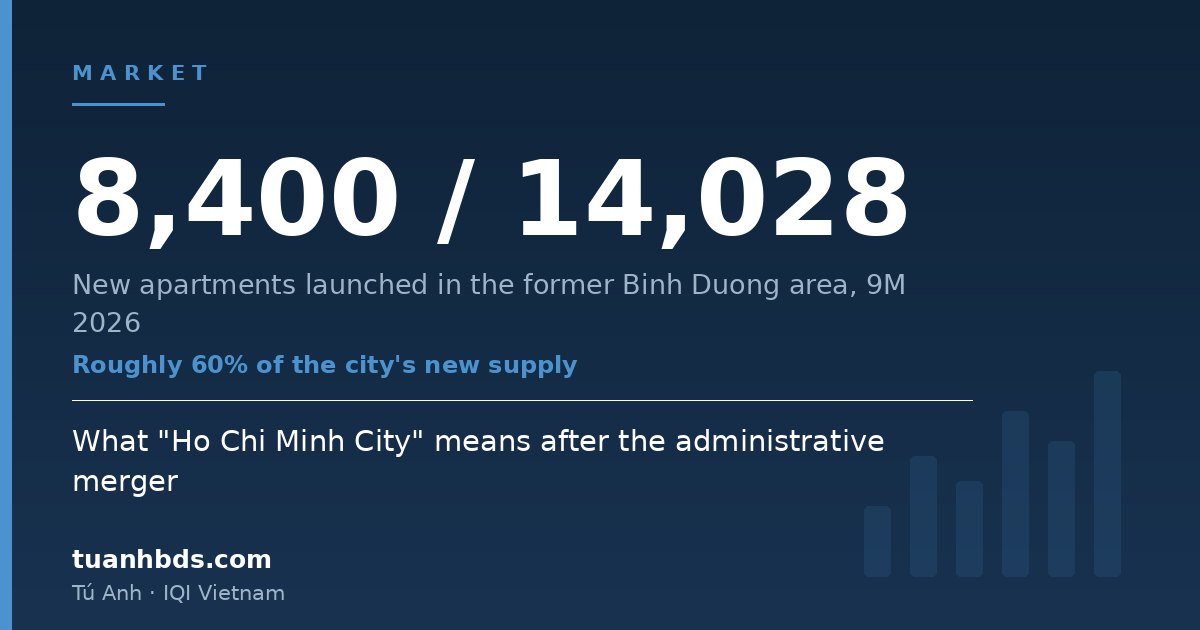
- New apartment launches, 9M 2026: 14,028
- Of which, in the former Binh Duong area: more than 8,400 — roughly 60%
- City-wide average primary price, Q3 2026: ~VND 75 million/m², down 2.3% q/q
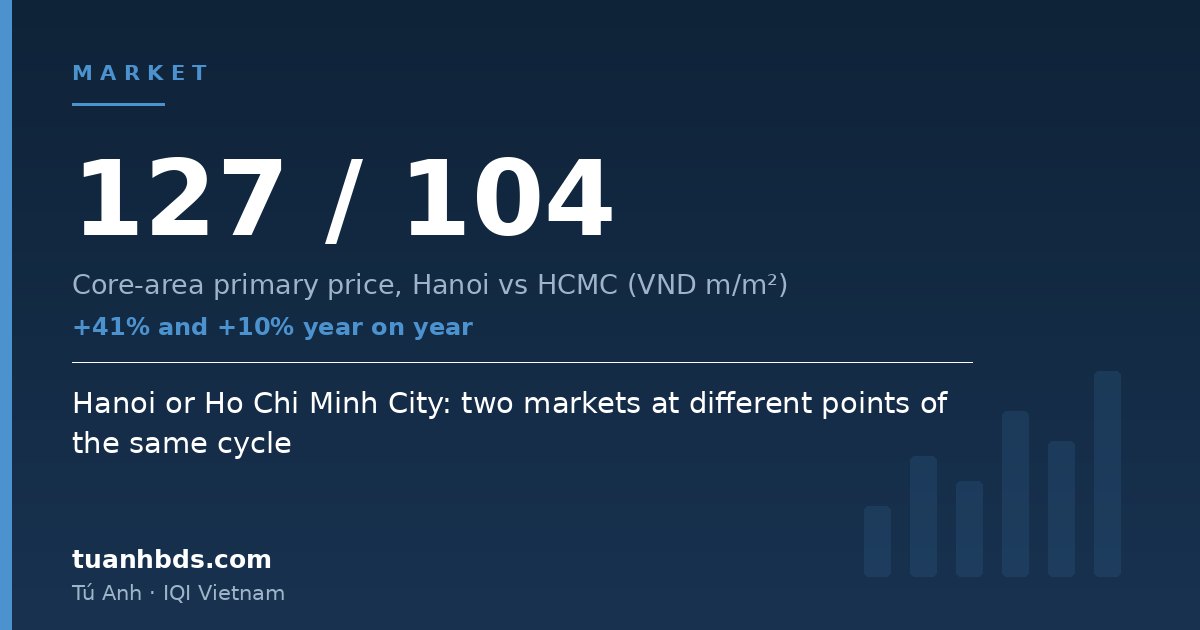
- Central area primary price, same quarter: ~VND 104 million/m², up 10% y/y
What actually changed
Ho Chi Minh City now covers a substantially larger administrative area, incorporating what were previously separate provinces — most relevantly, the former Binh Duong area.
Legally and statistically, apartments there are now Ho Chi Minh City apartments. Physically, nothing moved.
Why the average misleads
When a research house reports a city-wide primary price, it averages across everything inside the boundary. With roughly 60% of 2026's new supply located in the lower-priced outer area, the average is pulled down regardless of what happens in the core.
The same quarter therefore produced two true and apparently contradictory statements:
- City-wide primary prices fell 2.3% quarter on quarter
- Central-area primary prices rose 10% year on year
Both are correct. They describe different places.
Never benchmark a specific project against the city-wide average. Compare it with the same area and the same grade. A central-district unit assessed against a VND 75 million average will look expensive when it is not; an outer-area unit assessed against the same average will look reasonable when it may not be.
What the merger does not change
Travel time. An administrative boundary does not shorten a commute. Journey times depend on road and rail capacity, and the relevant infrastructure has its own timetable.
Day-to-day amenities. Schools, hospitals, retail and services are where they were. In newer outer-area developments, some are operating and some remain in planning — a distinction worth establishing on site rather than from a brochure.
The nature of local demand. Who lives and works in an area is a slow-moving fact. It does not change because the postal address does.
Why the supply moved out
Three forces, all rational from a developer's perspective:
- Land cost. The land price framework applied from 1 January 2026 raised the cost of developing in the core. Margins on outer-area land improved in relative terms.
- Legal readiness. Many outer-area projects had completed approvals earlier, while some core projects — particularly in Thu Thiem — remain constrained by unresolved land financial obligations.
- Price segment. With Grade A and B taking roughly 80% of new launches city-wide, demand at lower price points had nowhere to go but outward.
Reading this as an investor
The case for. Abundant supply means negotiating power now: time to inspect, genuine choice within a price band, and developers willing to discuss terms. For a buyer who will actually live or work in that area, the value proposition can be strong.
The case against. The same abundance works against you on exit. When more than 8,400 units launch in one area within nine months, a future seller competes not only with other individuals but with developers still holding stock — who can offer interest subsidies, extended payment terms and furniture packages that an individual cannot match.
The reconciliation. This is an area to buy for use or for a long hold, not for a quick resale. Three questions settle it:
- What is the real door-to-door travel time at peak hour, driven rather than estimated?
- Which amenities are operating today, not planned?
- Who is the buyer in five years, and what else will they be choosing between?
Ask how many units in the specific project remain unsold with the developer. That is the stock you will compete against when you sell, and it is the single most useful figure the sales office holds.
Frequently asked questions
What changed with the merger?
Ho Chi Minh City now covers a much larger administrative area, incorporating the formerly separate Binh Duong and Ba Ria–Vung Tau areas. Projects there are now reported as Ho Chi Minh City property, which changes what every city-wide statistic describes.
How much new supply is outside the historic core?
In the first nine months of 2026, Ho Chi Minh City recorded 14,028 new apartment launches, of which more than 8,400 were in the former Binh Duong area. Savills recorded more than 55% of Q3 new apartment supply in that area.
Did prices fall because of the merger?
The city-wide average fell partly because of composition. Primary prices averaged around VND 75 million per square metre city-wide in Q3 2026, down 2.3% quarter on quarter, while the central area averaged around VND 104 million and rose 10% year on year.
Does the merger shorten commuting times?
No. An administrative boundary change does not alter travel distance or road capacity. Journey times are determined by infrastructure, and the relevant projects have their own timelines.
Is this an opportunity or a risk for a foreign buyer?
Both, depending on the unit. Supply concentration in one area gives buyers negotiating power today and creates competition among sellers later. The key question is who buys the unit from you in five years.
Sources
- CBRE Vietnam — supply distribution across the expanded city, 9M 2026 — diendandoanhnghiep.vn
- Savills Vietnam — Q3 2026 supply distribution — vov.vn
- CBRE Vietnam — prices and absorption, Q3 2026 (CafeLand) — cafeland.vn
I am Tu Anh Nguyen (Ann), a real estate consultant at IQI Vietnam in Ho Chi Minh City. Before this I spent nearly eight years in Kuala Lumpur and moved home six times there — so I have been the foreigner trying to read someone else's property market, in someone else's language.
What that means in practice: I will put the awkward answers in writing. Remaining foreign quota in a specific building, the Department of Construction eligibility letter, the bank guarantee, the real walking distance to a metro station, what a unit like yours actually resold for. If a deal does not stand up, I would rather tell you before you wire a deposit.
Figures in this article come from published research and official documents, listed under Sources. This is general information for research purposes, not legal, tax or investment advice. Vietnamese property law is applied case by case — have a Vietnam-qualified lawyer review your specific transaction. Last updated: 26 October 2026.

Real estate consultant at IQI Vietnam, Ho Chi Minh City. Nearly eight years living and working in Kuala Lumpur before returning to Vietnam. Works in English and Vietnamese.
About Ann →