Rental yield for a foreign landlord: gross, net, and the gap between them
Tu Anh Nguyen (Ann) · 26 October 2026 · 3 min read
When a sales agent says a unit "yields 6%", that is a gross figure. What you receive is materially less. This article gives you the full formula so you can run it yourself.
Gross yield = twelve months of rent ÷ total capital deployed
Net yield = (twelve months of rent − all operating costs) ÷ total capital deployed
The second one is the number that pays you.
Start with the denominator
The first error is in the divisor. Total capital deployed is not the contract price. It includes:
- Contract price
- Value added tax
- The 2% maintenance fund
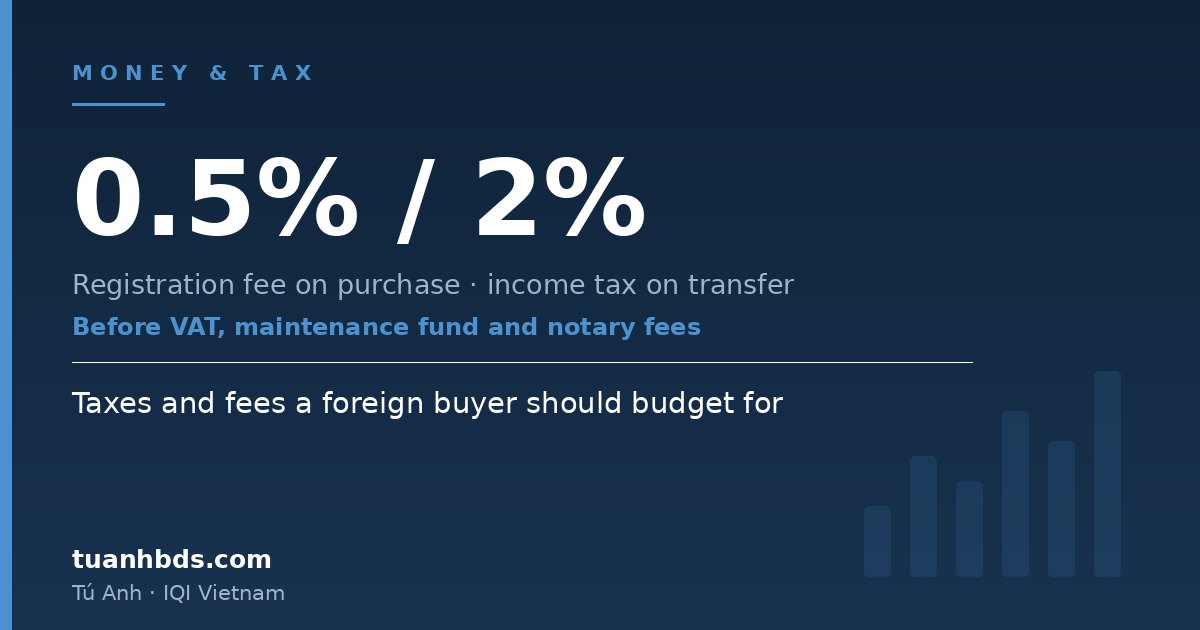
- Registration fee of 0.5% on assessed value
- Notary, certificate and appraisal fees
- Fit-out and furnishing, which for a shell-handover unit is substantial and is required before the unit can be let at all
For a unit handed over as shell, the furnishing cost alone can move the yield calculation by a noticeable margin — and it is the item most often excluded from the agent's arithmetic.
The seven costs taken off the numerator
| Cost | Note |
|---|---|
| Building management fee | Charged monthly, and continues while the unit is empty |
| Vacancy | Each tenant change typically costs weeks to months of rent |
| Tax on rental income | Rental income is taxable and should be declared |
| Agency fee to find a tenant | Usually priced in months of rent, recurring at each turnover |
| Repairs | Air conditioning, water heaters, appliances |
| Furniture replacement | Rental furniture depreciates far faster than owner-occupied |
| Insurance | Where held |
And if the purchase is financed, interest comes off as well. With investment-purpose borrowing in Vietnam reaching around 14% per year depending on channel, that single item can turn an apparently attractive proposal into negative cash flow.
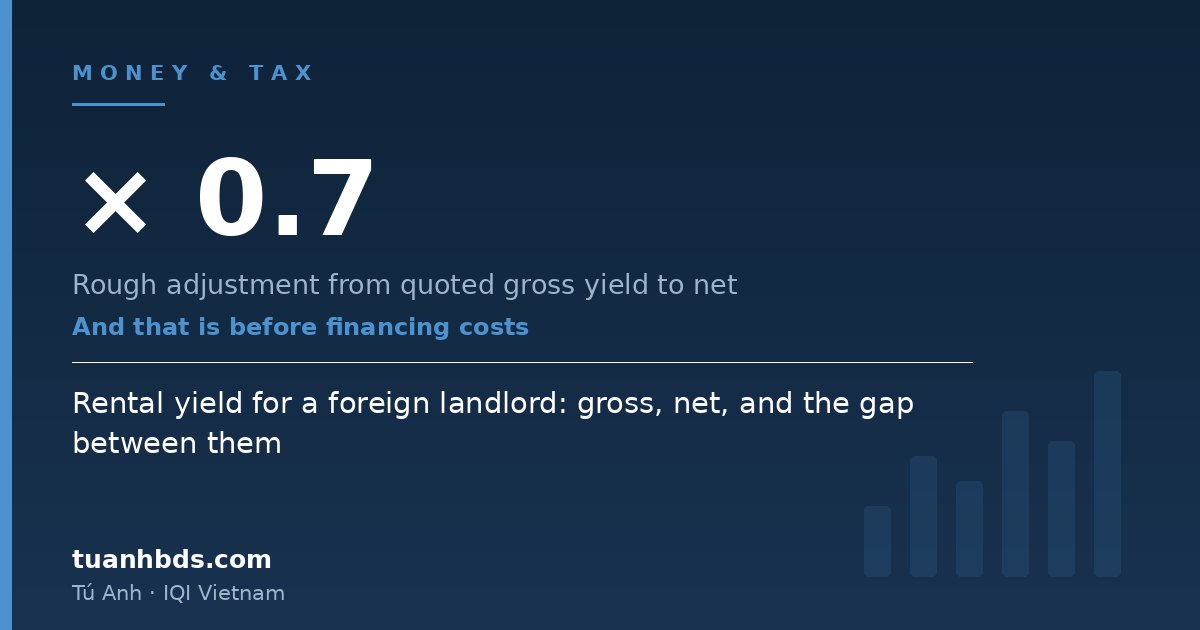
Take the gross yield you were quoted and multiply by 0.7. That lands closer to net before financing costs. It is an approximation, not a calculation — but if the result is already unattractive, there is no need to go further.
Two questions that matter more than the headline rent
What is the actual occupancy of that building?
Not the market average — that specific building. A tower where many owners are letting simultaneously pushes achievable rents down and vacancy up. Check by asking building management how many units are currently let, and by counting listings for the same building and unit type on local portals. Dozens of near-identical listings is a supply signal.
Who is the target tenant?
Durable yield comes from having a clearly defined tenant pool, not from a high asking rent. Expatriate professionals, domestic office workers and young families behave differently and pay differently. If nobody can name the tenant, the yield projection is theoretical.
The encouraging part: leasing is holding up
This is the strongest argument for a cash-flow strategy in Vietnam right now.
| Segment, Ho Chi Minh City, Q3 2026 | Occupancy |
|---|---|
| Office | close to 90%, average rent around VND 870,000/m²/month |
| Retail | 92% |
| Serviced apartments | 85%, over 7,000 units across 146 projects, supported by long-stay tenants |
| Residential for sale — absorption of new supply | 45% |
The gap between those groups is the key insight: demand to use Vietnamese property is solid; demand to own it at current prices is not.
For an investor, that argues for building the case on rental cash flow rather than on short-term capital appreciation — particularly while secondary prices are still adjusting, having eased around 4% in Q3 2026.
If net yield after all costs is below what you earn on cash deposits in your home currency, the investment only makes sense if you expect capital appreciation. That may be a reasonable expectation in Vietnam over a long horizon — but call it what it is, size it accordingly, and do not let a gross yield figure disguise it as income.
Frequently asked questions
How is rental yield calculated properly?
Gross yield is twelve months of rent divided by total capital deployed. Net yield subtracts every operating cost first. The figure quoted in sales material is almost always gross, and the gap between the two is wider in Vietnam than many buyers assume.
What costs should be deducted?
Building management fees, vacancy between tenants, taxes on rental income, agency fees to find each tenant, repairs, furniture replacement, and insurance. If the purchase is financed, interest comes off as well.
Is the leasing market in Vietnam healthy?
Stronger than the sales market. In Q3 2026 serviced apartments in Ho Chi Minh City ran at about 85% occupancy across more than 7,000 units in 146 projects, offices at close to 90% and retail at 92%, while absorption of newly launched apartments for sale was only 45%.
What is a realistic quick adjustment from gross to net?
Multiplying a quoted gross yield by roughly 0.7 gets closer to net before financing costs. It is a sanity check rather than a calculation, but if the result is unattractive the proposal does not warrant deeper analysis.
Does rental income need to be declared?
Yes. Rental income is taxable and should be declared, and keeping rental contracts and tax receipts strengthens the overall documentation of the investment.
Sources
- Savills Vietnam — office, retail and serviced apartment occupancy, Q3 2026 — phunumoi.net.vn
- Savills Vietnam — Ho Chi Minh City leasing market, Q3 2026 — batdongsan.baoxaydung.vn
- CBRE Vietnam — absorption and secondary pricing, Q3 2026 — diendandoanhnghiep.vn
I am Tu Anh Nguyen (Ann), a real estate consultant at IQI Vietnam in Ho Chi Minh City. Before this I spent nearly eight years in Kuala Lumpur and moved home six times there — so I have been the foreigner trying to read someone else's property market, in someone else's language.
What that means in practice: I will put the awkward answers in writing. Remaining foreign quota in a specific building, the Department of Construction eligibility letter, the bank guarantee, the real walking distance to a metro station, what a unit like yours actually resold for. If a deal does not stand up, I would rather tell you before you wire a deposit.
Figures in this article come from published research and official documents, listed under Sources. This is general information for research purposes, not legal, tax or investment advice. Vietnamese property law is applied case by case — have a Vietnam-qualified lawyer review your specific transaction. Last updated: 26 October 2026.

Real estate consultant at IQI Vietnam, Ho Chi Minh City. Nearly eight years living and working in Kuala Lumpur before returning to Vietnam. Works in English and Vietnamese.
About Ann →