Thu Thiem and the international financial centre: what is built, what is approved, what is still a plan
Tu Anh Nguyen (Ann) · 26 October 2026 · 3 min read
Thu Thiem appears in nearly every pitch made to foreign investors in Ho Chi Minh City. This article separates three categories that marketing material tends to merge: what is built, what is approved and under way, and what remains a plan.
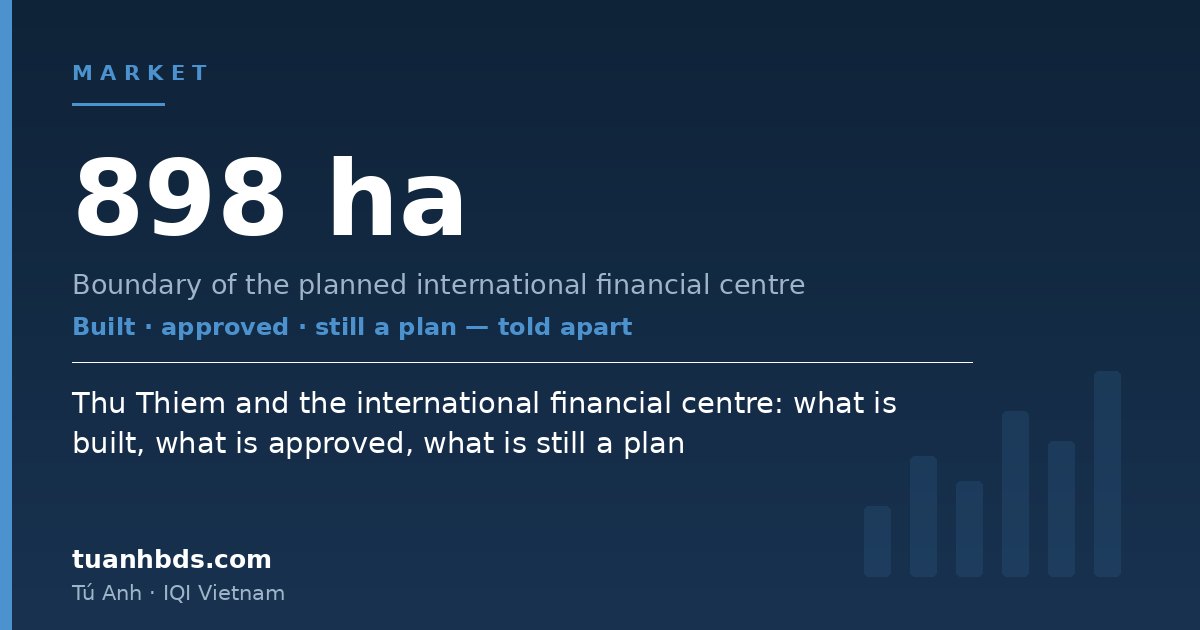
- International financial centre boundary: ~898 hectares — Sai Gon ward ~146 ha, Ben Thanh ward ~20 ha, Thu Thiem ~563 ha, river surface ~64 ha
- New political and administrative centre: ~VND 29,591 billion, built 2026–2028, operational expected September 2028
- Metro line 2 Ben Thanh – Thu Thiem: construction started, investment above VND 46,000 billion
- Grade A pipeline 2026–2029: ~6,627 units city-wide, over 60% in the east
It is not only Thu Thiem
A common misreading: the financial centre is often assumed to sit entirely within Thu Thiem. It does not. The boundary spans the established central area and the new urban area, creating a corridor with its own policy treatment.
Thu Thiem is the largest component by land area, but the Ben Thanh–Sai Gon side already has operating commercial infrastructure, established offices and existing metro connectivity.
For a buyer this is the practical point: two halves of the same designated zone are at completely different stages of development. One has functioning city fabric; the other has large land parcels, new infrastructure and several lots that have not started.
Under construction, verifiably
The administrative centre. Preliminary investment around VND 29,591 billion, construction over 2026–2028, expected operational from September 2028.
This is the item with the clearest near-term effect on local property. When government functions relocate, a large body of people works there every day — generating genuine residential and rental demand that does not depend on international financial institutions arriving.
Metro line 2, Ben Thanh – Thu Thiem. Construction started, investment above VND 46,000 billion, with the line oriented to connect directly to the new administrative core.
Established in principle, not yet in substance
The financial ecosystem itself.
The intended model spans traditional and specialised financial services — international banking, asset management, capital markets, green finance, fintech. The boundary and the policy direction exist.
What does not yet exist is the ecosystem. Attracting major financial institutions requires a legal framework with genuine flexibility, synchronised infrastructure and a transparent investment environment — and that is a multi-year process whose pace no developer controls.
When sales material cites the financial centre, ask two questions: Is this unit inside the 898-hectare boundary or merely near it? and In which year does the benefit you are describing arrive? The second question is usually the harder one to get answered.
Three risks the brochures leave out
1. Infrastructure timing. Every appreciation argument based on infrastructure assumes the infrastructure arrives on schedule. Large transport projects in Vietnam have a track record of slipping; metro line 1 is the nearest verifiable example. Re-run your model assuming two to three years of delay. If it still works, the decision is sound.
2. Legal status at lot level. Not every land lot in Thu Thiem is in the same position. Some projects remain constrained by unresolved land financial obligations — a procedural matter outside the developer's control, and the usual cause of multi-year delays in issuing ownership certificates. Legal procedure, not capital or demand, currently sets the pace of the area's development.
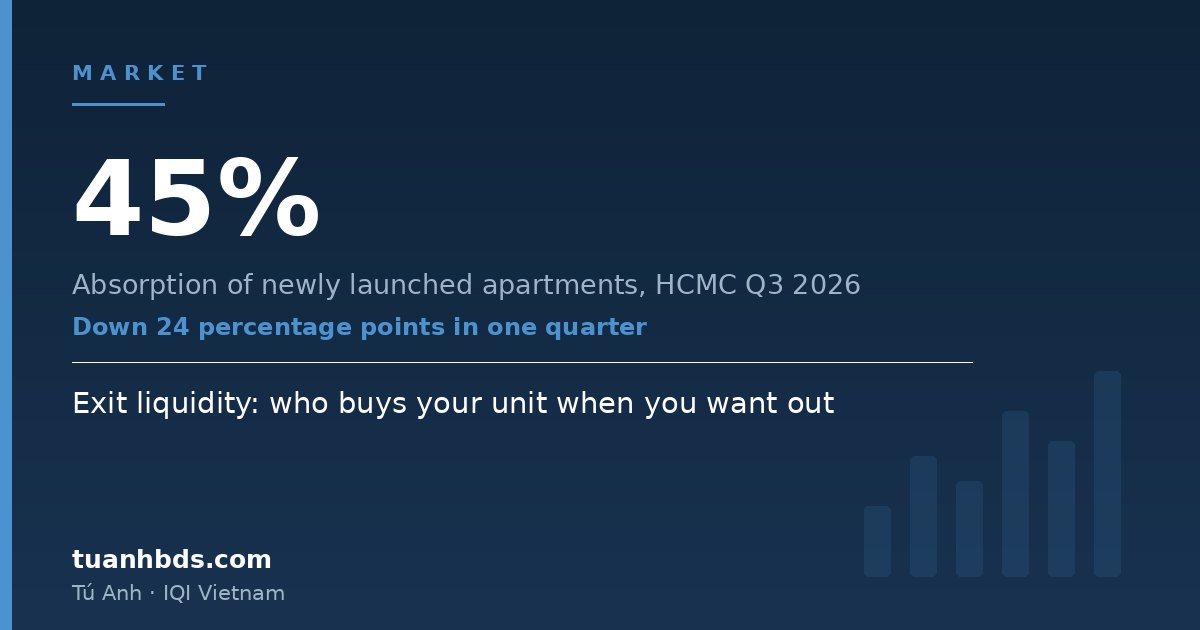
3. Secondary liquidity. This risk is the most underweighted. At very high price points the pool of buyers able to purchase is thin by definition. Q3 2026 showed absorption of newly launched apartments city-wide at just 45%. Add around 6,627 Grade A units arriving by 2029, over 60% in the east, and a seller in 2030 faces a crowded field.
If you are considering Thu Thiem
Three questions to settle before looking at floor plans:
- Use or investment? For a resident working centrally, infrastructure delay is tolerable. For an investor, the timetable is the central variable.
- What is your holding period? Thu Thiem is a five to ten year proposition, not a two-year one. The capital must be able to sit still for that long.
- What share of total assets? A large, thinly traded, timeline-dependent asset should not dominate a portfolio.
"Have the land financial obligations for this project been settled, and can you show documentation?"
In Thu Thiem specifically, this has been the dividing line between projects that progressed and projects that did not.
Frequently asked questions
How large is the planned international financial centre?
Around 898 hectares, spanning the existing central area and the Thu Thiem new urban area: roughly 146 hectares in Sai Gon ward, 20 hectares in Ben Thanh ward, 563 hectares in Thu Thiem and about 64 hectares of Saigon River surface.
What is actually under construction?
The new political and administrative centre at Thu Thiem, with preliminary investment of around VND 29,591 billion, is under construction for 2026 to 2028 and expected to be operational from September 2028. Metro line 2 from Ben Thanh to Thu Thiem has started construction with total investment above VND 46,000 billion.
Is the financial ecosystem itself in place?
No. The boundary and policy direction are established; attracting major financial institutions depends on the legal framework and synchronised infrastructure, and is a multi-year process.
Why are some Thu Thiem projects stalled?
Legal procedure rather than funding or demand is the main determinant. Some land lots remain constrained by unresolved land financial obligations, which blocks construction and delays ownership certificates.
How much new Grade A supply is coming to the area?
Savills expects around 6,627 new Grade A apartments in Ho Chi Minh City over 2026 to 2029, with more than 60% of future Grade A supply in the eastern area including Thu Thiem.
Sources
- Ho Chi Minh City authorities — Thu Thiem and the international financial centre — ttbc-hcm.gov.vn
- HCMC People's Council — eastern area infrastructure and metro lines — hdnd.hochiminhcity.gov.vn
- Savills Vietnam — Grade A supply pipeline 2026–2029 — tienphong.vn
- CBRE Vietnam — market conditions, Q3 2026 — diendandoanhnghiep.vn
I am Tu Anh Nguyen (Ann), a real estate consultant at IQI Vietnam in Ho Chi Minh City. Before this I spent nearly eight years in Kuala Lumpur and moved home six times there — so I have been the foreigner trying to read someone else's property market, in someone else's language.
What that means in practice: I will put the awkward answers in writing. Remaining foreign quota in a specific building, the Department of Construction eligibility letter, the bank guarantee, the real walking distance to a metro station, what a unit like yours actually resold for. If a deal does not stand up, I would rather tell you before you wire a deposit.
Figures in this article come from published research and official documents, listed under Sources. This is general information for research purposes, not legal, tax or investment advice. Vietnamese property law is applied case by case — have a Vietnam-qualified lawyer review your specific transaction. Last updated: 26 October 2026.

Real estate consultant at IQI Vietnam, Ho Chi Minh City. Nearly eight years living and working in Kuala Lumpur before returning to Vietnam. Works in English and Vietnamese.
About Ann →