The 50-year ownership term: what actually happens at year 50
Tu Anh Nguyen (Ann) · 26 October 2026 · 4 min read
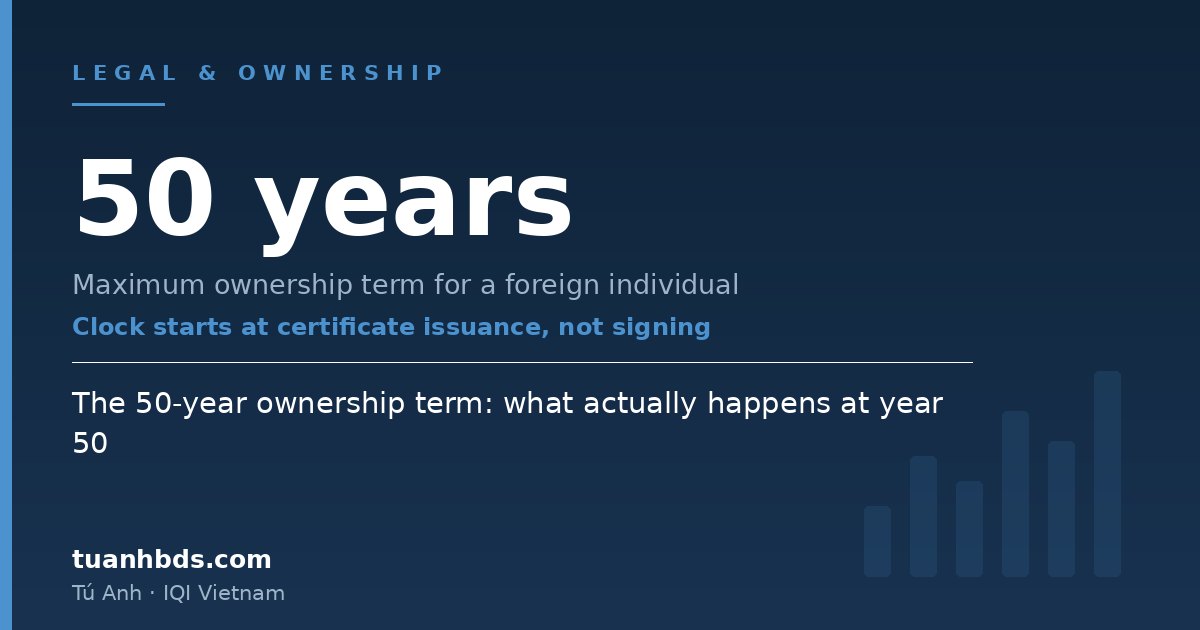
The 50-year term is the single most misread feature of Vietnamese property for foreign buyers. Some treat it as fatal; others are told it is "basically freehold" and stop asking. Neither is right, and the difference between them is worth a lot of money.
- Term runs up to 50 years from the date the ownership certificate is issued
- The start date is certificate issuance, not contract signing or handover
- Extension is provided for, via application to the provincial People's Committee before expiry
- A foreign individual married to a Vietnamese citizen is treated differently
The start date is the part that costs money
Your term does not begin when you sign. It does not begin when you collect the keys. It begins when the ownership certificate is issued.
In Vietnam, the gap between signing an off-plan contract and holding a certificate routinely runs to several years — construction, completion, acceptance, then the certificate process itself. For some projects it has run considerably longer where the developer's land obligations were unresolved.
Read in the right direction, that gap is neutral to slightly favourable: the clock has not started while you wait.
Read in the wrong direction, it is a trap: buyers who assume the term started at signing will overstate their remaining years when they come to sell, and will have priced their exit wrong.
"On what date was, or will be, the ownership certificate issued for this unit?"
If the answer is a confident date for an off-plan unit, be sceptical. Nobody can promise that date. What you can establish is whether the developer's land financial obligations are settled, because that is the usual cause of multi-year certificate delays. Ask for documentation, not reassurance.
Extension: probable, not automatic
The framework provides for extending the term. The process runs through the provincial People's Committee, with an application made ahead of expiry supported by the ownership certificate and passport documentation.
Model it as probable but administrative. The distinction matters because of how you should price the asset:
- If you assume automatic renewal, you will pay close to what a Vietnamese buyer pays
- If you assume no renewal, you will not buy at all
- The honest position is in between, and it should be reflected in the price you negotiate rather than in a hope you carry
The resale problem arrives long before expiry
This is the part that experienced investors focus on and first-time buyers miss entirely.
Your exit price is set by what the next buyer is purchasing. In year 10, they buy roughly 40 years plus an extension expectation — barely different from what you bought. In year 30, they buy roughly 20 years plus the same expectation, and the discount becomes visible.
Two consequences:
The term is a slow-acting cost, not a cliff. It does not hit you in year 49. It starts shaping pricing somewhere in the middle, and it compounds.
Your natural exit is a Vietnamese buyer. Domestic buyers hold housing on a stable long-term basis and are not pricing a depleting term. That is why, in practice, the discount is often smaller than the arithmetic implies — provided the unit is one that domestic buyers actually want.
If your exit depends on selling to a Vietnamese buyer, then the unit must appeal to a Vietnamese buyer: location relative to schools and work, layout, building management, and a price that sits sensibly against domestic comparables. A unit designed purely around an expatriate brief — and priced at an expatriate premium — has a thinner exit than its brochure suggests.
Where this sits in the current market
Context matters for anyone modelling an exit today. In Q3 2026, the Ho Chi Minh City market showed an absorption rate of only 45% on newly launched apartment supply, down 24 percentage points quarter on quarter, with secondary prices easing around 4% in the quarter.
In a market where domestic liquidity is already strained, a foreign seller carrying a depleting term is not in a strong position to be in a hurry. That is an argument for holding period discipline, not an argument against buying.
How to price the term properly
Three practical steps:
- Establish the actual or expected certificate date, and write it into your model as the start of the term.
- Model your exit at a realistic holding period — five to ten years is the normal range here — and ask what the remaining term will be at that point. In most cases it will still be comfortably long.
- Sanity check your entry price against domestic comparables, not against what other foreign buyers paid in the same building. The foreign-buyer pool is small; the domestic pool is the market.
- Written confirmation of the certificate issuance date, or the current status of the application
- Evidence that the developer's land financial obligations for the project are settled
- The clause in your contract that deals with certificate issuance timing and what happens if it slips
- Written confirmation of the transfer conditions and costs if you sell before receiving the certificate
Frequently asked questions
When does the 50-year clock start?
From the date the ownership certificate is issued, not from the date you sign the sale and purchase agreement and not from handover. In Vietnam those dates can be separated by years, so the effective term you receive depends heavily on when the certificate is actually issued.
Can the term be extended?
The framework provides for extension. An extension request is made to the provincial People's Committee ahead of expiry, with the ownership certificate and passport documentation. Because this is an administrative process rather than an automatic right, treat the extension as probable but not guaranteed when you model the investment.
Does the remaining term affect resale value?
Yes, and earlier than most buyers expect. A buyer in year 30 is purchasing roughly 20 years of remaining term plus an extension expectation. In markets with similar structures, pricing pressure typically appears well before the final decade.
Is a Vietnamese buyer affected by the same limit?
No. Vietnamese citizens hold housing on a stable long-term basis. This asymmetry matters on exit, because the deepest pool of buyers in Vietnam is domestic and is not pricing a depleting term.
What happens if I sell to a Vietnamese buyer?
This is the common exit route and the reason the term discount is often smaller in practice than theory suggests. Confirm the mechanics for your specific certificate with a Vietnam-qualified lawyer before relying on it.
Sources
- Decree 95/2024/ND-CP guiding the Housing Law (Thu Vien Phap Luat) — thuvienphapluat.vn
- Vietnam Briefing — ownership term and extension procedure — www.vietnam-briefing.com
- CBRE Vietnam — Ho Chi Minh City housing market, Q3 2026 — diendandoanhnghiep.vn
I am Tu Anh Nguyen (Ann), a real estate consultant at IQI Vietnam in Ho Chi Minh City. Before this I spent nearly eight years in Kuala Lumpur and moved home six times there — so I have been the foreigner trying to read someone else's property market, in someone else's language.
What that means in practice: I will put the awkward answers in writing. Remaining foreign quota in a specific building, the Department of Construction eligibility letter, the bank guarantee, the real walking distance to a metro station, what a unit like yours actually resold for. If a deal does not stand up, I would rather tell you before you wire a deposit.
Figures in this article come from published research and official documents, listed under Sources. This is general information for research purposes, not legal, tax or investment advice. Vietnamese property law is applied case by case — have a Vietnam-qualified lawyer review your specific transaction. Last updated: 26 October 2026.

Real estate consultant at IQI Vietnam, Ho Chi Minh City. Nearly eight years living and working in Kuala Lumpur before returning to Vietnam. Works in English and Vietnamese.
About Ann →