Due diligence checklist before you wire a deposit
Tu Anh Nguyen (Ann) · 26 October 2026 · 3 min read
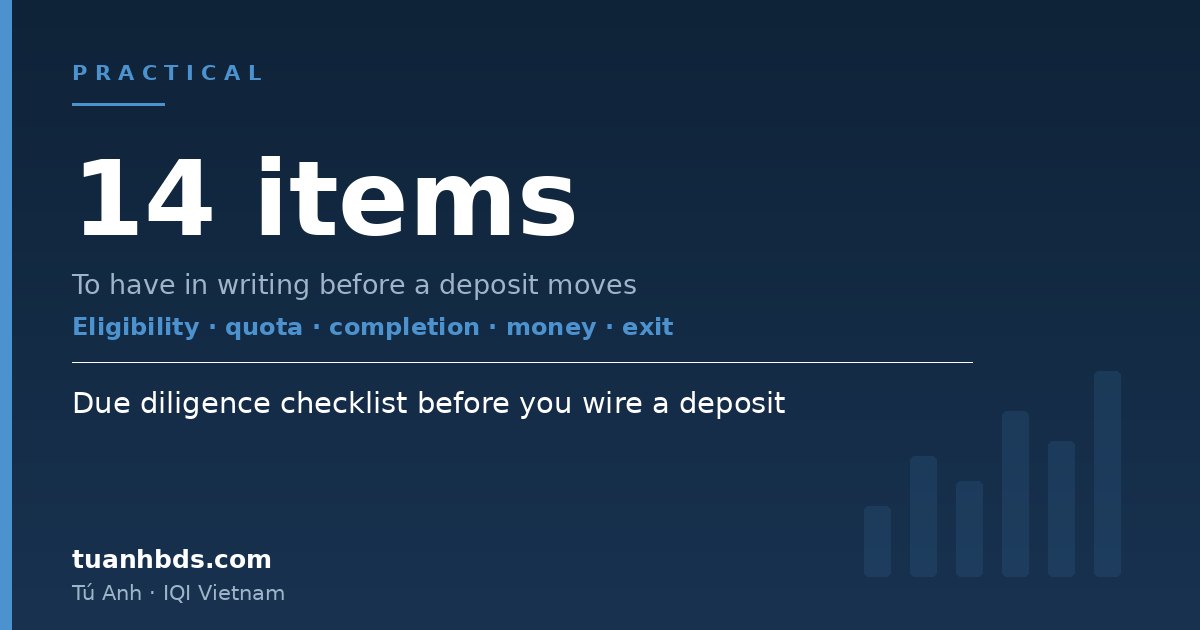
This is the article to print. Fourteen items, grouped by what each one protects against. Everything should be in writing, dated, and specific to your unit — not a brochure claim and not a verbal assurance.
Group 1 — Can you legally buy this at all?
1. Project approved to sell to foreign buyers. Written confirmation that this project, in this location, may be sold to foreign organisations and individuals. Areas designated for national defence and security are excluded.
2. Remaining foreign quota for your specific block. Four numbers, dated: total residential apartments in the block, number already held or contracted to foreign owners, number remaining, and whether your unit sits inside it. The 30% cap is counted per block, including where blocks share a podium.
3. For landed property — the area ceiling. A maximum of 250 houses for foreign owners across an area with a population equivalent to one ward, benchmarked at 10,000 people, aggregated across every project in that area.
These three are gates. Run them before floor plans, views and furniture packages. Buyers who run the sequence in reverse are the ones who end up negotiating about a deposit from a weak position.
Group 2 — Will the building actually be delivered?
4. Department of Construction eligibility letter. Confirming the project may sell housing to be formed in the future. Check the reference number, date, and that it covers your phase and block.
5. Bank guarantee certificate naming your unit. Which bank issued it, whether it is project-wide or per unit, what it covers, and when it expires. Obtain the instrument naming your unit — not a copy of the master arrangement.
6. Status of the developer's land financial obligations. The quiet cause of multi-year delays in issuing ownership certificates. A project can be built, handed over and occupied while certificates remain stuck.
7. Construction permit and foundation acceptance record.
8. The developer's recent delivery record. Which projects are under construction now, and the handover status of the last two completed. A visible, recent, on-time record in Vietnam is a materially different proposition from a first-time or long-dormant developer.
Group 3 — Is the contract balanced?
9. Payment schedule tied to verified construction milestones, not calendar dates. Note how much falls due before foundation acceptance — money paid earliest buys the least protection.
10. Late-handover penalty on the developer, read beside the late-payment penalty on you. If the asymmetry is large, that is the clearest available statement of how the relationship is viewed.
11. Area basis — net usable or gross. And what happens if the delivered area differs from the contract. Market reports quote net usable area; not all contracts do.
12. Contract transfer clause. Conditions and cost of transferring before handover. This is your early exit, and it needs to exist before you need it.
Group 4 — Money and exit
13. Payment channel confirmed in writing, before the first instalment: which account, held by whom, at which bank, and what receipt you get for each payment. Every payment should come from your own foreign source into the named contract. The evidence trail built on the way in is what supports taking proceeds out later.
14. Full cost breakdown to keys. Headline price plus VAT, plus the 2% maintenance fund, plus the 0.5% registration fee on assessed value, plus notary, certificate and appraisal fees, plus fit-out if handover is shell. One number, in writing.
Independent legal review. Use a Vietnam-qualified lawyer who was not introduced by the developer. It is a small proportion of the purchase cost and the only part of the process working solely for you.
A site visit at an inconvenient hour. Weekday morning rush, not a weekend showing. Walk the route to the metro station and time it. Look at how many units in the building are dark at nine in the evening.
What a refusal tells you
Some developers answer slowly; large organisations have processes. That is normal.
A refusal to put block-level quota, land obligation status or the guarantee certificate in writing — from a project actively marketing to international buyers — is different. It usually means either the answer is unfavourable or the internal tracking cannot produce it. Neither is a reason to send money.
In a market where absorption of new supply fell to 45% in Q3 2026 and developers postponed more than 40% of planned launches, you have time. The pressure to decide quickly is a sales technique, not a market condition.
Frequently asked questions
What is the single most important document?
The Department of Construction letter confirming the project is eligible to sell housing to be formed in the future. Without it, a developer should not be taking money for unbuilt units, and no other document compensates for its absence.
Why check the foreign quota before anything else?
Because it is a gate rather than a detail. A project can have hundreds of unsold units and still be closed to you if the 30% foreign cap in that specific block is full. The cap is counted per block, not per project.
What is commonly missed?
Three things: the status of the developer's land financial obligations, the bank guarantee certificate naming the specific unit, and the contract transfer clause that defines whether an early exit is possible and at what cost.
How long should due diligence take?
Long enough to receive written answers. If a sales process will not survive a week of written questions, that is information about the counterparty rather than an obstacle to overcome.
Do I need a Vietnamese lawyer?
For a transaction of this size in a legal system you do not read, independent legal review is a small proportion of the purchase cost and the only part of the process working solely for you. Use a lawyer who is not introduced by the developer.
Sources
- Decree 95/2024/ND-CP guiding the Housing Law — thuvienphapluat.vn
- Quantity of housing foreign entities may own (Thu Vien Phap Luat) — thuvienphapluat.vn
- Taxes and fees on property transactions, 2026 (AZTAX) — aztax.com.vn
- CBRE Vietnam — market conditions, Q3 2026 — diendandoanhnghiep.vn
I am Tu Anh Nguyen (Ann), a real estate consultant at IQI Vietnam in Ho Chi Minh City. Before this I spent nearly eight years in Kuala Lumpur and moved home six times there — so I have been the foreigner trying to read someone else's property market, in someone else's language.
What that means in practice: I will put the awkward answers in writing. Remaining foreign quota in a specific building, the Department of Construction eligibility letter, the bank guarantee, the real walking distance to a metro station, what a unit like yours actually resold for. If a deal does not stand up, I would rather tell you before you wire a deposit.
Figures in this article come from published research and official documents, listed under Sources. This is general information for research purposes, not legal, tax or investment advice. Vietnamese property law is applied case by case — have a Vietnam-qualified lawyer review your specific transaction. Last updated: 26 October 2026.

Real estate consultant at IQI Vietnam, Ho Chi Minh City. Nearly eight years living and working in Kuala Lumpur before returning to Vietnam. Works in English and Vietnamese.
About Ann →