How to check a building's remaining foreign quota before you pay
Tu Anh Nguyen (Ann) · 26 October 2026 · 3 min read
This is a short article about one question, because that question decides whether everything else is worth your time.
- Cap: 30% of residential apartments in a building, foreign owners combined
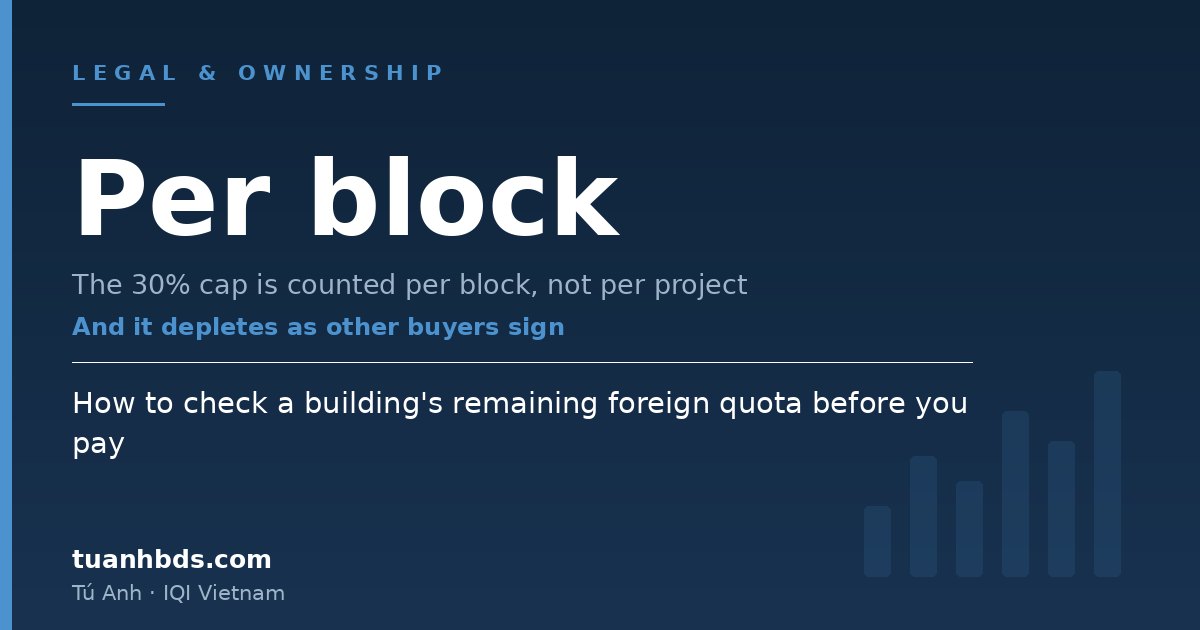
- Counted per block or section, even where blocks share one podium
- It depletes over the life of sales — early buyers consume it
- Exceeding it leaves you with the value, not the property
Why verbal assurance is not enough
A sales agent telling you "there is still quota" is not a document, is not dated, and is not binding on anyone. Quota moves as other buyers sign. Between your site visit and your deposit, it can move.
The failure mode is specific and it does happen: a foreign buyer places a deposit, proceeds through contract preparation, and discovers at registration that the block quota is exhausted. What follows is a negotiation about the deposit, conducted from a weak position, in a language the buyer does not read.
The exact wording to use
Send this in writing — email is fine, and the fact that it is written is the point:
"Please confirm in writing, as at today's date: (1) the total number of residential apartments in Block ___; (2) the number already owned by or contracted to foreign organisations and individuals; (3) the remaining number available to foreign buyers in that block; and (4) whether unit ___ is within that remaining allocation."
Four numbers, one date, one named block, one named unit. A developer that sells to foreign buyers regularly will have this to hand.
Developers are not obliged to run their sales process around your convenience, and some answer slowly. But a flat refusal to put the block-level number in writing, from a project actively marketing to foreign buyers, is itself information. It usually means either the quota is tight, or the internal tracking is not good enough to answer — and neither is a reason to send money.
Block, not project — the detail that catches people
Decree 95/2024/ND-CP counts the 30% separately for each block or section sharing a podium.
The practical scenario: a project has three towers. Tower A was marketed heavily at an international roadshow and is at quota. Towers B and C are barely touched. The overall project is well under 30%.
An agent quoting a project-level figure is giving you a number that does not govern your purchase. Always name the block.
Landed houses work differently
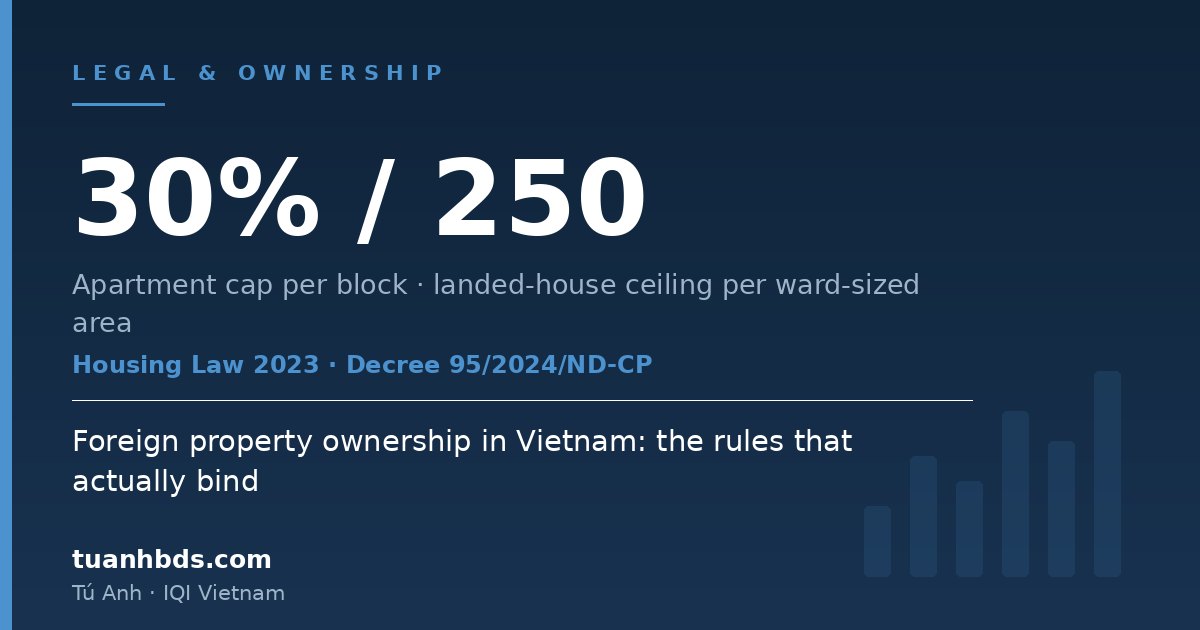
If you are looking at villas or townhouses, the quota logic changes shape entirely. The limit is 250 houses for foreign owners across an area with a population equivalent to one ward — benchmarked at 10,000 people — and it applies to the area regardless of how many projects sit inside it.
So the question changes from "how much quota is left in this project?" to "how much is left in this area, across every project competing for the same ceiling?"
That is a harder question, and it is one where a local consultant who tracks several projects in the same district has information that no single developer's sales office will volunteer.
Sequence this correctly
Quota is a gate, not a detail. Put it before the enjoyable parts of the process:
- Is the project approved to sell housing to foreign buyers at all?
- What is the remaining foreign quota for this block, in writing, dated?
- Is the specific unit within that allocation?
- Only then — floor plans, views, payment schedules, furniture packages.
Buyers who run this sequence in reverse are the ones who end up negotiating about a deposit.
The answer also tells you something about demand. A block at 28% of 30% has been bought heavily by other foreign buyers, which may be reassuring — or may mean you are buying into a unit type whose future resale market is other foreign buyers competing against each other with a depleting term. Neither reading is automatic, but the number is worth having before you commit.
Frequently asked questions
Is the 30% quota counted per project or per building?
Per apartment building. Where a development has several blocks or sections sharing one podium, Decree 95/2024/ND-CP counts the 30% separately for each block, so quota cannot be averaged across towers in the same project.
Who knows how much quota is left?
The developer tracks it, and it is reflected in the registration process. As a buyer you should ask for a written, dated statement of the remaining foreign quota for the specific block, rather than relying on a verbal assurance from a sales agent.
What happens if I buy beyond the quota?
Where an acquisition exceeds the permitted limits, the foreign owner is entitled to the value of the property rather than ownership of the property itself. In practice that converts a real asset into a monetary claim you did not choose.
Can a developer reserve quota for me?
Reservation practices vary and are commercial rather than statutory. If a developer offers to hold quota, ask for the commitment and its expiry in the written reservation document, and check what happens to your deposit if the quota is gone when you proceed.
Does the quota apply to landed houses too?
Landed houses use a different limit: a maximum of 250 houses for foreign owners across an area with a population equivalent to one ward, benchmarked at 10,000 people, regardless of how many projects sit in that area.
Sources
- Decree 95/2024/ND-CP, quantity of housing foreign entities may own (Thu Vien Phap Luat) — thuvienphapluat.vn
- ATA Legal — the 250-house ceiling per 10,000-population area — ata-legal.com
- Vietnam Briefing — foreign ownership caps and consequences of exceeding them — www.vietnam-briefing.com
I am Tu Anh Nguyen (Ann), a real estate consultant at IQI Vietnam in Ho Chi Minh City. Before this I spent nearly eight years in Kuala Lumpur and moved home six times there — so I have been the foreigner trying to read someone else's property market, in someone else's language.
What that means in practice: I will put the awkward answers in writing. Remaining foreign quota in a specific building, the Department of Construction eligibility letter, the bank guarantee, the real walking distance to a metro station, what a unit like yours actually resold for. If a deal does not stand up, I would rather tell you before you wire a deposit.
Figures in this article come from published research and official documents, listed under Sources. This is general information for research purposes, not legal, tax or investment advice. Vietnamese property law is applied case by case — have a Vietnam-qualified lawyer review your specific transaction. Last updated: 26 October 2026.

Real estate consultant at IQI Vietnam, Ho Chi Minh City. Nearly eight years living and working in Kuala Lumpur before returning to Vietnam. Works in English and Vietnamese.
About Ann →