Vietnam compared with other regional markets: what is genuinely different
Tu Anh Nguyen (Ann) · 26 October 2026 · 4 min read

This article is written for a specific reader: someone who already owns property outside their home country — in Malaysia, Singapore, Thailand, Korea or Japan — and is now assessing Vietnam. You do not need an introduction to cross-border property. You need to know where your existing mental model breaks.
- Ownership term — most foreign individuals hold for up to 50 years, not in perpetuity
- Quotas are per block — 30% of residential apartments in a building, counted by block
- Exit depends on domestic buyers — the foreign pool is capped by design
- Repatriation is decided at entry — by the documentation of your inbound payments
1. The term changes your discount rate, not your decision
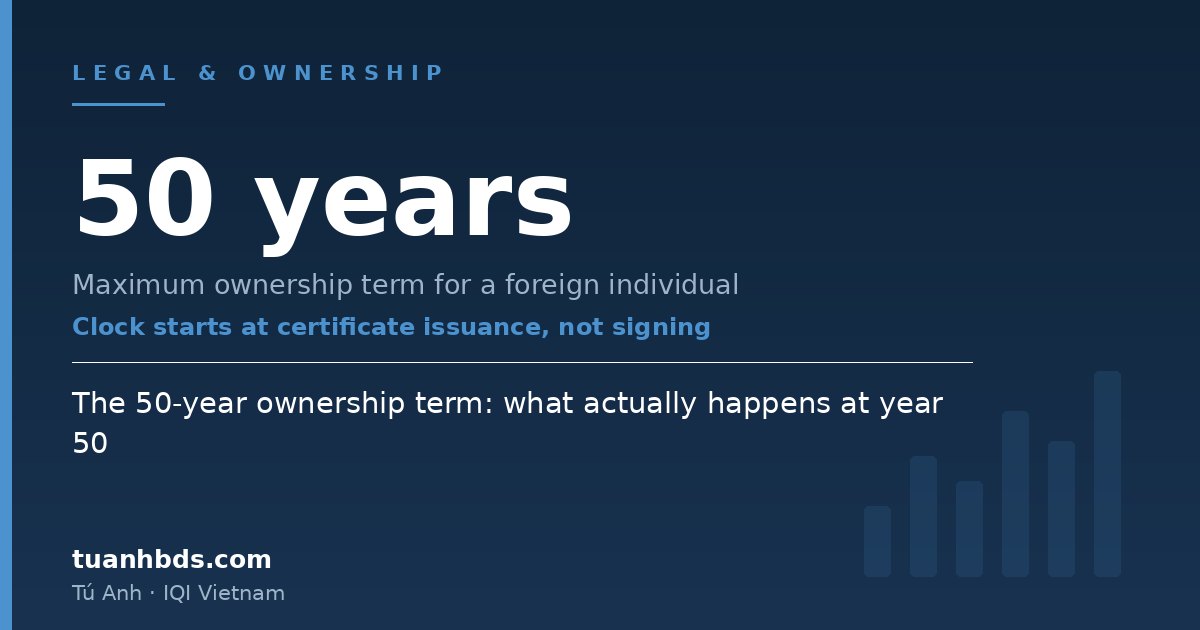
Most foreign individuals hold Vietnamese housing for up to 50 years from certificate issuance, renewable once.
If you are used to freehold or to very long leasehold, the practical adjustments are:
- The clock starts at certificate issuance, not at signing — and in Vietnam that gap can be years
- The effect on value is gradual, appearing in pricing well before expiry
- The mitigation is that your natural buyer is domestic, and domestic buyers hold on a stable long-term basis
One important exception: a foreign individual married to a Vietnamese citizen living in Vietnam is placed outside the 50-year regime under Article 20(2) of Housing Law 2023. If that applies to you, much of this section does not.
2. Quotas behave differently from the ones you know
Several regional markets use minimum price thresholds or state-level approval. Vietnam uses volume caps:
- 30% of residential apartments in a building, counted per block — including where blocks share a podium
- 250 landed houses for foreign owners across an area with a population equivalent to one ward (benchmarked at 10,000 people), aggregated across every project in that area
The second is the one that surprises people. It is a shared, depleting resource across competing projects in the same area, not a per-project allowance. In a district actively marketing villas to international buyers, early entrants consume it.
The consequence of exceeding a cap is also specific: the foreign owner becomes entitled to the value rather than the property.
3. Exit liquidity deserves more weight than entry price
This is where investors from mature markets most often misjudge Vietnam.
| Indicator, Ho Chi Minh City Q3 2026 | |
|---|---|
| Absorption of newly launched apartments | 45%, −24 percentage points q/q |
| Absorption, nine months | 43% |
| Secondary apartment price | ~VND 60m/m², −4% q/q |
| New launches | 3,267 units, −53% y/y |
And when you sell, your competition is usually the developer, still holding unsold stock in the same or a neighbouring project, able to offer interest subsidies, extended payment schedules and furniture packages. You can offer none of these.
If your experience is in a market with a deep, continuously traded secondary sector, assume a materially longer time to transact and build that into your holding period.
4. Repatriation is decided before you buy, not when you sell
In several regional markets, moving sale proceeds out is primarily a banking formality at the end.
In Vietnam, the ability to repatriate rests on the documentary chain built on the way in: foreign-sourced funds, through a lawful banking channel, documented against a named contract and a named unit, with every receipt retained.
Buyers who pay in cash, through a third party, or via a relative's domestic account complete the purchase and break the chain. That is the single most common unforced error among foreign buyers here, and it only becomes visible years later.
Everything you already know about cross-border property still applies: location fundamentals, building management quality, developer track record, and the discipline of not over-sizing a single illiquid position. Vietnam does not require a new philosophy — it requires four specific adjustments to an existing one.
The growth question, answered honestly
The macro case is genuine. Ho Chi Minh City GRDP rose 9.06% over the first nine months of 2026 and 9.86% in Q3 alone, with around 92,000 property transactions nationwide in the quarter.
But 2026 has been a clear demonstration that GDP growth and residential returns are different variables. The economy expanded strongly while absorption fell 24 percentage points in a single quarter. The binding constraint was the cost of credit and the gap between asking prices and what owner-occupiers can pay.
A reasonable conclusion: Vietnam is a credible long-horizon allocation with a real demographic and urbanisation story — underwritten on a five-to-ten-year hold, with capital that can sit still, and priced so that it does not require a rising market to work.
Frequently asked questions
What is structurally different about Vietnam?
Four things: a time-limited ownership term for most foreign individuals, quotas counted per building block, a domestic buyer pool that dominates exit liquidity, and a documentation chain on the way in that governs repatriation on the way out.
Is Vietnam cheaper than comparable regional markets?
Entry prices vary widely by location and grade, so a single comparison is misleading. The more useful comparison is total round-trip cost and exit liquidity rather than headline price per square metre.
How does exit liquidity compare?
This is where investors from more mature markets are most often surprised. Absorption of newly launched apartments in Ho Chi Minh City was 45% in Q3 2026 and 43% across nine months, with secondary prices easing about 4% in the quarter.
Can I apply the same underwriting I use elsewhere?
Not without adjustment. A model that assumes perpetual title, a deep secondary market and straightforward repatriation will overstate returns in Vietnam. Adjust for term, quota, liquidity and documentation.
Does the growth story compensate?
The macro growth is real: Ho Chi Minh City GRDP rose 9.06% over nine months of 2026 and 9.86% in Q3. But GDP growth and residential returns are different variables, and 2026 has shown them diverging.
Sources
- CBRE Vietnam — Ho Chi Minh City housing market, Q3 2026 — diendandoanhnghiep.vn
- HoREA — Ho Chi Minh City GRDP and transaction volume, Q3 2026 — batdongsan.baoxaydung.vn
- Decree 95/2024/ND-CP — ownership caps for foreign entities — thuvienphapluat.vn
I am Tu Anh Nguyen (Ann), a real estate consultant at IQI Vietnam in Ho Chi Minh City. Before this I spent nearly eight years in Kuala Lumpur and moved home six times there — so I have been the foreigner trying to read someone else's property market, in someone else's language.
What that means in practice: I will put the awkward answers in writing. Remaining foreign quota in a specific building, the Department of Construction eligibility letter, the bank guarantee, the real walking distance to a metro station, what a unit like yours actually resold for. If a deal does not stand up, I would rather tell you before you wire a deposit.
Figures in this article come from published research and official documents, listed under Sources. This is general information for research purposes, not legal, tax or investment advice. Vietnamese property law is applied case by case — have a Vietnam-qualified lawyer review your specific transaction. Last updated: 26 October 2026.

Real estate consultant at IQI Vietnam, Ho Chi Minh City. Nearly eight years living and working in Kuala Lumpur before returning to Vietnam. Works in English and Vietnamese.
About Ann →