Choosing a property consultant in Vietnam: what to demand, and how to test it
Tu Anh Nguyen (Ann) · 26 October 2026 · 3 min read
This article is published by a consultant, so read it with that in mind. It is more useful to tell you how to judge people in my position — including me — than to ask you to take anything on trust.
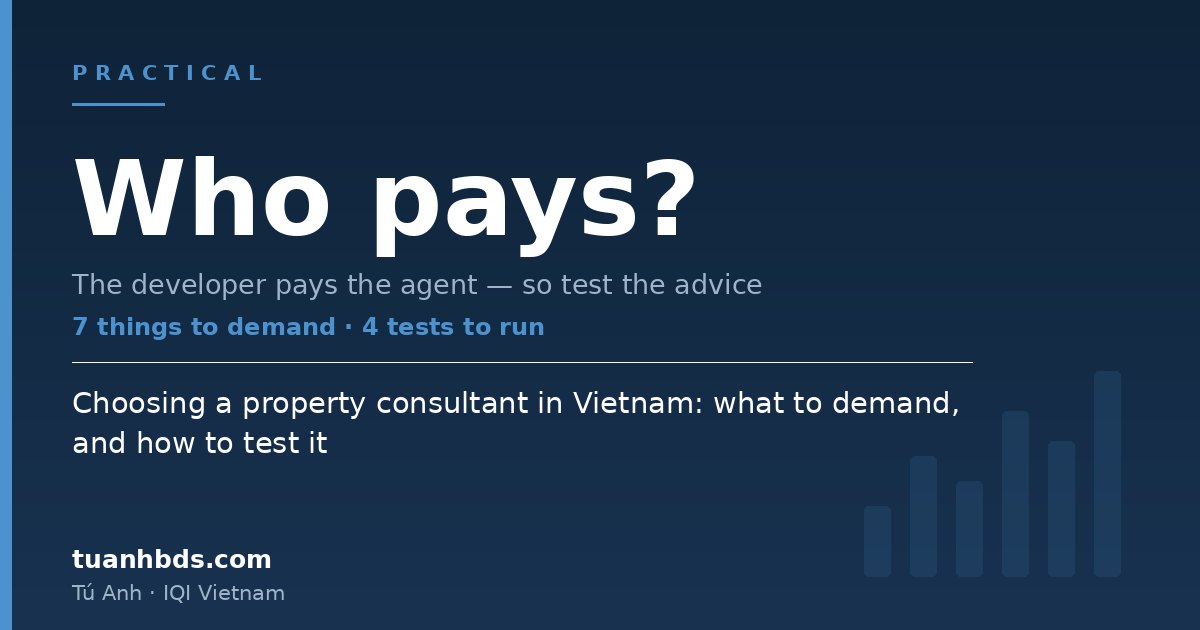
In the primary market, the developer pays the agent's commission on units sold. This is standard practice and not improper. But it means the person advising you is paid when a transaction happens, and not paid when the right advice is "this one is not for you."
Everything below is about how to work with that structure rather than pretend it does not exist.
Seven things to require
1. Written answers on what binds. Project eligibility to sell to foreign buyers. Remaining foreign quota for the specific block, dated. The Department of Construction eligibility letter, by number and date. The bank guarantee certificate naming your unit. The status of the developer's land financial obligations.
A consultant who treats these as the starting point is doing the job. One who treats them as paperwork to handle later is not.
2. A full cost breakdown to keys. One number, itemised: price, VAT, the 2% maintenance fund, 0.5% registration fee, notary and certificate fees, fit-out if handover is shell.
3. Comparables you can check. What similar units in the building and the area actually transacted at — not asking prices.
4. The drawbacks, stated unprompted. Every unit has them.
5. An explanation of how their project list is selected. A consultant presenting only one developer's stock is a sales channel.
6. Communication in a language you read fully. Not a summary of a Vietnamese document — the document, and an explanation of what each clause does.
7. Willingness to work alongside your own lawyer. Resistance here is disqualifying.
Four tests you can run in one meeting
Ask what is wrong with the unit. The answer separates advisers from sales staff faster than any other question. Specific drawbacks — the west-facing afternoon heat, the lift ratio, unsold developer stock on the same floors — indicate someone who has actually assessed the asset.
Ask when you should not buy. A consultant who cannot describe a situation in which the honest recommendation is to wait has not thought about your position, only about the transaction.
Ask about the last unit they sold in this building, and the one they advised someone against. The second half of that question is the revealing one.
Ask about market conditions and listen for whether the numbers are real. Q3 2026: absorption of newly launched apartments at 45%, down 24 percentage points in the quarter; secondary prices easing around 4%; more than 40% of planned launches postponed. Someone describing this market as uniformly strong is either uninformed or managing you.
In a market with absorption at 45%, there is no genuine scarcity pressure on an ordinary unit. If you are being told to decide today, that urgency is a technique, not a market condition. A consultant who creates artificial time pressure in this market has told you what kind of relationship it will be.
Where a consultant is not enough
Three things to arrange independently:
Legal review. A Vietnam-qualified lawyer, not introduced by the developer. This is the only party in the process working solely for you, and the cost is a small fraction of the purchase.
Tax advice. Particularly on repatriation, which is determined by how you document payments on the way in.
Your own site visit. At a weekday peak hour, not a weekend showing. Walk the route to the station and time it. Return in the evening and count the dark windows.
Why I publish this
I am Tu Anh Nguyen (Ann), a consultant at IQI Vietnam in Ho Chi Minh City. Before this I spent nearly eight years in Kuala Lumpur and moved home six times there — so I have been on the other side of this: the foreigner trying to read someone else's property market, in someone else's language, relying on people whose incentives I could not see.
What I took from that is simple. The adviser you remember is the one who told you the thing you did not want to hear, early enough for it to be useful. The most valuable sentence I say to clients is some version of "not this one" — and if I am wrong about that, I would rather be wrong in writing, where you can hold me to it.
That is the standard I would apply to anyone you are considering, including me.
Frequently asked questions
Who pays the agent in Vietnam?
In the primary market the developer pays commission on units sold. That is normal and not improper, but it means the agent is remunerated for a transaction occurring, which you should factor into how you weigh their advice.
What should I require from a consultant?
Written answers on the things that bind: project eligibility to sell to foreign buyers, remaining quota for the specific block, the Department of Construction eligibility letter, the bank guarantee, the status of land financial obligations, and a full cost breakdown to keys.
What is the best test of a consultant?
Ask what is wrong with the unit they are recommending. A consultant who can describe specific drawbacks, and name a situation in which you should not buy, is giving you usable information.
Should I use a lawyer as well?
Yes. A consultant and a lawyer do different jobs. Use a Vietnam-qualified lawyer who was not introduced by the developer, as the only party in the process working solely for you.
Does working with one consultant limit my options?
It should not. A consultant who only ever presents projects from one developer is operating as a sales channel rather than an adviser, and you should ask how their project list is selected.
Sources
- CBRE Vietnam — market conditions, Q3 2026 — diendandoanhnghiep.vn
- Decree 95/2024/ND-CP — ownership caps for foreign entities — thuvienphapluat.vn
- Savills Vietnam — Q3 2026 supply and absorption — nhipsongnhadat.vn
I am Tu Anh Nguyen (Ann), a real estate consultant at IQI Vietnam in Ho Chi Minh City. Before this I spent nearly eight years in Kuala Lumpur and moved home six times there — so I have been the foreigner trying to read someone else's property market, in someone else's language.
What that means in practice: I will put the awkward answers in writing. Remaining foreign quota in a specific building, the Department of Construction eligibility letter, the bank guarantee, the real walking distance to a metro station, what a unit like yours actually resold for. If a deal does not stand up, I would rather tell you before you wire a deposit.
Figures in this article come from published research and official documents, listed under Sources. This is general information for research purposes, not legal, tax or investment advice. Vietnamese property law is applied case by case — have a Vietnam-qualified lawyer review your specific transaction. Last updated: 26 October 2026.

Real estate consultant at IQI Vietnam, Ho Chi Minh City. Nearly eight years living and working in Kuala Lumpur before returning to Vietnam. Works in English and Vietnamese.
About Ann →