Buying off-plan in Vietnam: the two documents that protect you
Tu Anh Nguyen (Ann) · 26 October 2026 · 4 min read
Most new apartment stock in Vietnam is sold before it exists. That is normal here and not a reason to stay away — but it means you are extending unsecured credit to a developer in instalments, and the protections are specific documents rather than general goodwill.
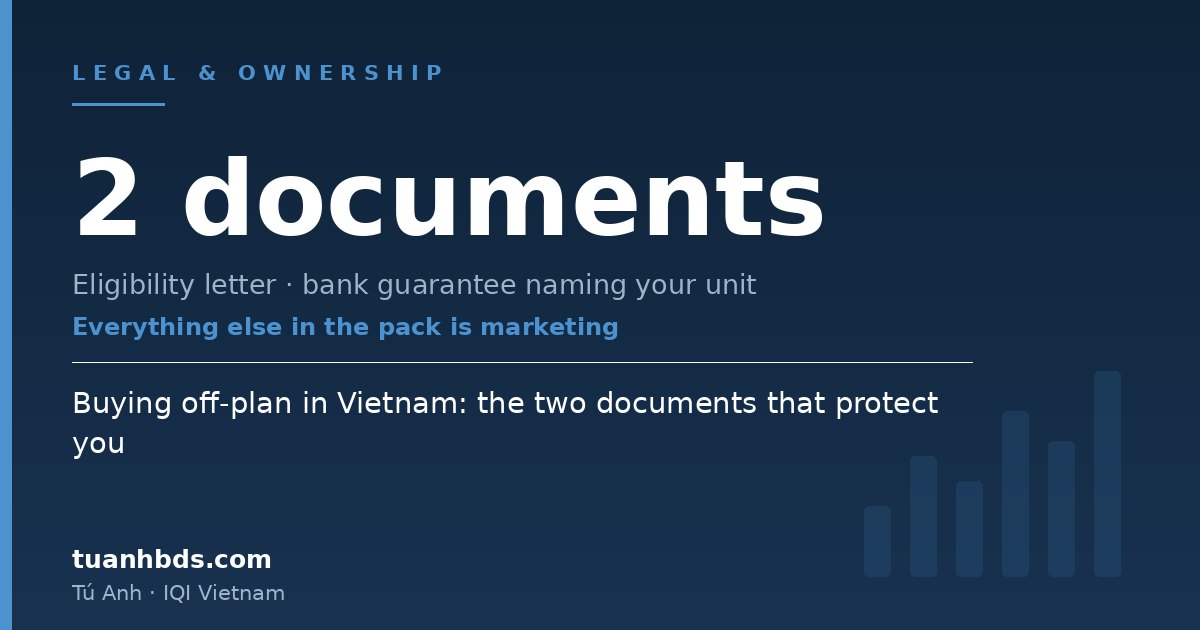
- Department of Construction eligibility letter — confirms the project may legally sell future housing at all
- Bank guarantee — a commercial bank stands behind the developer's financial obligations to you
Everything else in the sales pack is marketing. These two are the structure.
Document one: eligibility to sell future housing
Before a developer can take money for unbuilt units, the project must be confirmed by the provincial Department of Construction as eligible to sell housing to be formed in the future.
Ask for the document: its reference number, its date, and the project phase it covers. Not a line in a brochure, not a verbal confirmation, not a photograph of a certificate framed in a sales gallery.
Two checks on the document itself:
- Does it cover your phase and your block? Large projects are approved in stages. An eligibility letter for phase 1 says nothing about phase 3.
- How old is it? An eligibility letter issued well before the current sales round is worth confirming is still current.
Document two: the bank guarantee
A commercial bank guarantees the developer's financial obligations to buyers of future housing. If the developer fails to deliver, the guarantee is the mechanism that is supposed to make you whole.
Three questions that separate a real protection from a nominal one:
- Which bank issued it? A guarantee is only as good as the issuer.
- Is it project-wide or per unit? Both exist. If per unit, you need the certificate that names your unit, not a copy of the master arrangement.
- What exactly does it cover, and for how long? Scope and expiry vary.
The most common gap is not a missing guarantee but a buyer who never obtained the instrument naming their unit. The master arrangement sits with the developer; your protection is the document you hold. Request it at contract signature and keep the original with your transfer records.
The third thing, which is not a document
The developer's land financial obligations.
This is the quiet cause of multi-year delays in issuing ownership certificates in Vietnam. A project can be built, handed over and occupied while the certificate process remains stuck because land obligations between the developer and the state are unresolved.
You will not find this in a brochure. Ask directly whether the land financial obligations for the project have been settled, and ask for documentation. In Thu Thiem in particular, this has distinguished projects that progressed from projects that did not.
Why this matters more in the current market
Completion risk is not constant. It rises when developers are short of cash.
The Q3 2026 picture in Ho Chi Minh City:
| Indicator | Q3 2026 |
|---|---|
| Absorption of newly launched apartments | 45%, down 24 percentage points quarter on quarter |
| Supply planned for Q3 launch that was postponed | more than 40% |
| Q4 2026 expected launches | about 6,000 units, nearly 30% below the original forecast |
Postponement is a rational response to weak demand and it is not in itself a danger signal. But it does tell you that developers are managing liquidity carefully — which is precisely when the strength of your guarantee matters.
"Which other projects of yours are currently under construction, and what is the handover status of the last two you completed?"
A developer with a visible, recent, on-time delivery record in Vietnam is a materially different proposition from a first-time or long-dormant one, regardless of how good the renderings are.
The payment schedule is a risk instrument
Read it as one. The questions:
- How much is due before foundation acceptance? Money paid very early buys you the least protection.
- Is each instalment tied to a verified construction milestone, or to calendar dates?
- What is the penalty on the developer for late handover, and how does it compare with the penalty on you for late payment? If the asymmetry is large, that is the clearest statement of how the relationship is viewed.
- What are the conditions and costs of transferring the contract before handover? That is your early exit.
- Eligibility letter from the Department of Construction — number, date, phase
- Bank guarantee certificate naming your unit — issuing bank, scope, expiry
- Written status of the developer's land financial obligations
- Construction permit and foundation acceptance record
- The late-handover penalty clause, read side by side with the late-payment clause
- The contract transfer clause — conditions and cost
Frequently asked questions
What is the Department of Construction eligibility letter?
A written confirmation from the provincial Department of Construction that a project is eligible to sell housing to be formed in the future. Without it, a developer should not be taking money for unbuilt units. Ask for the document itself, with its number and date, not a summary.
What does the bank guarantee cover?
It is a guarantee from a commercial bank covering the developer's financial obligations to buyers of future housing. Ask which bank issued it, whether it covers the whole project or is issued per unit, and request the certificate that names your unit.
Is off-plan riskier in the current market?
Completion risk is higher when developers are under funding pressure. In Q3 2026, more than 40% of the supply planned for launch in Ho Chi Minh City was postponed, and absorption of newly launched apartments fell to 45%. Both point to developers managing cash carefully.
What else should be checked before a deposit?
The land allocation decision and the status of the developer's land financial obligations, the construction permit, and the foundation acceptance record. Unsettled land obligations are a common cause of multi-year delays in issuing ownership certificates.
Can I transfer an off-plan contract before handover?
Contract transfer before taking handover is commonly provided for, but conditions and costs vary by contract. Have the specific transfer clause read before you sign, because it defines your early exit route.
Sources
- CBRE Vietnam — Ho Chi Minh City housing market, Q3 2026 — diendandoanhnghiep.vn
- Market analysis — postponed launches and absorption, Q3 2026 — baomoi.com
- Savills Vietnam — Ho Chi Minh City market overview, Q3 2026 — nhipsongnhadat.vn
I am Tu Anh Nguyen (Ann), a real estate consultant at IQI Vietnam in Ho Chi Minh City. Before this I spent nearly eight years in Kuala Lumpur and moved home six times there — so I have been the foreigner trying to read someone else's property market, in someone else's language.
What that means in practice: I will put the awkward answers in writing. Remaining foreign quota in a specific building, the Department of Construction eligibility letter, the bank guarantee, the real walking distance to a metro station, what a unit like yours actually resold for. If a deal does not stand up, I would rather tell you before you wire a deposit.
Figures in this article come from published research and official documents, listed under Sources. This is general information for research purposes, not legal, tax or investment advice. Vietnamese property law is applied case by case — have a Vietnam-qualified lawyer review your specific transaction. Last updated: 26 October 2026.

Real estate consultant at IQI Vietnam, Ho Chi Minh City. Nearly eight years living and working in Kuala Lumpur before returning to Vietnam. Works in English and Vietnamese.
About Ann →