Money in, money out: the paperwork that decides whether you can repatriate
Tu Anh Nguyen (Ann) · 26 October 2026 · 3 min read
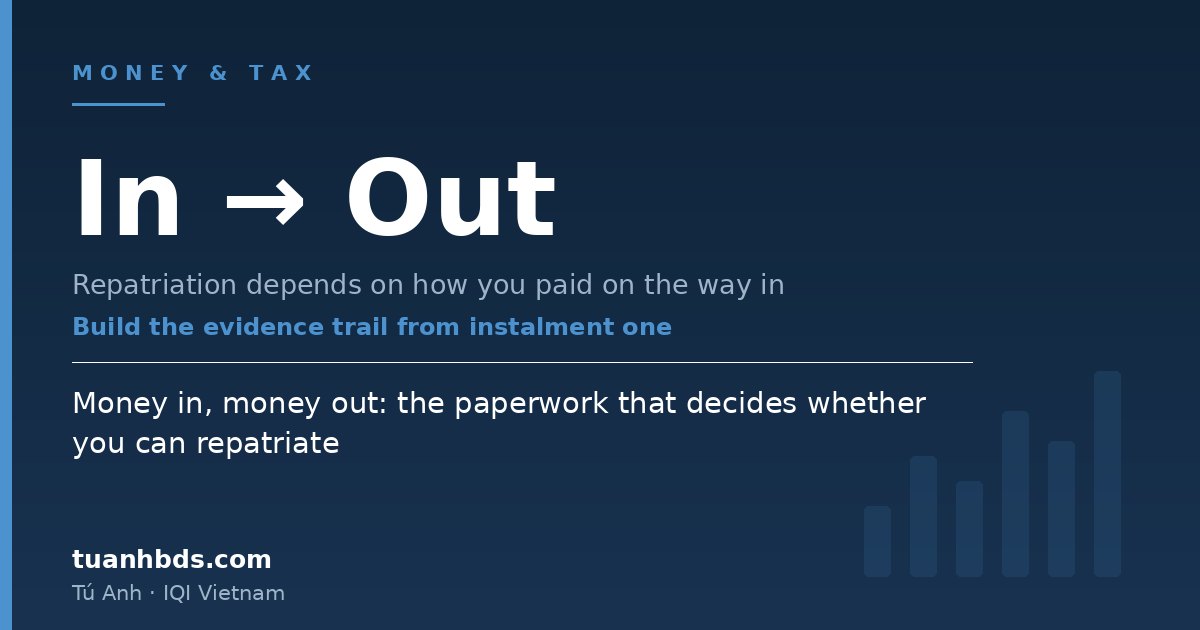
Of all the ways a foreign property purchase in Vietnam goes wrong, this is the one that is entirely preventable and the one that is discovered too late. The problem never appears at purchase. It appears years later, at sale, when the money needs to leave.
The paperwork that lets proceeds leave Vietnam is created on the way in, not on the way out. Every instalment you pay is either building that evidence trail or quietly breaking it.
Why the exit depends on the entry
When you eventually sell and want to move the proceeds abroad, you will be asked to demonstrate the legitimate origin of the funds that bought the asset and the lawful nature of the transaction.
If every payment came from abroad, through a banking channel, documented against a named contract and a named unit, that demonstration is straightforward.
If payments were made in cash, or routed through a friend's account, or paid by a company unconnected to you, the asset may still be yours — but the chain of evidence linking your foreign money to it has gaps. Those gaps are not fatal in every case, but closing them retrospectively is expensive, slow, and sometimes impossible.
At purchase, nobody is checking hard. The developer wants the sale; the agent wants the commission; the paperwork feels like friction. At sale, someone checks carefully. Build for the second moment, not the first.
What to set up before the first instalment
Have these confirmed in writing before any money moves:
- The receiving account. Which account, held by whom, at which bank. It should be the developer's account named in your contract — not an individual's account, not a related company you have not heard of.
- The payment route from your side. Confirm with your own bank how the transfer will be described and what documentation they will retain.
- The receipt you will get for each instalment, naming the project, the unit, the amount and the date.
- Currency handling, confirmed by the bank rather than by the sales office.
Then keep every piece of paper. Not photographs — the originals, in one file, for as long as you hold the asset.
The nominee question
Someone will suggest it. Usually framed helpfully: the quota is full, or the structure is "simpler", or "everyone does it".
What it actually means: the property is in another person's name. You have a private agreement with that person. If the relationship ends badly, if they die, if their circumstances change, your position rests on an arrangement built to sit outside the ownership rules.
The law is also explicit about the consequence of exceeding permitted limits: the foreign party is entitled to the value of the property rather than the property itself. That is the outcome the structure was supposedly designed to avoid.
Paying for a unit from a Vietnamese relative's domestic account — even when the unit is correctly in your name — creates the same evidential gap. The ownership is clean; the money trail is not. Keep the funds flowing from your own foreign source into the named contract.
Build the file from day one
A complete holding file, kept for the life of the investment:
| Document | When you get it |
|---|---|
| Inbound transfer instructions and bank confirmations | each instalment |
| Sale and purchase agreement, signed, with annexes | at signing |
| Receipt for each instalment, naming the unit | each instalment |
| Department of Construction eligibility letter | before deposit |
| Bank guarantee certificate naming your unit | at signing |
| Handover minutes | at handover |
| Ownership certificate | at issuance |
| Tax and fee payment receipts | as incurred |
| Rental contracts and rental tax receipts, if let | ongoing |
The last row matters more than people expect. If the property generated income, the income side of the file should be as clean as the purchase side.
If your file already has gaps
Some readers will be part way through a purchase made less carefully. The position is not hopeless, and the right sequence is:
- Stop and document what exists before adding more transactions on top.
- Get a Vietnam-qualified lawyer to review the chain, specifically the link between your foreign funds and the named asset.
- Make every future payment clean, whatever happened before. A partial trail is better than none, and the remaining instalments are usually the larger part.
This is one of the few areas in Vietnamese property where spending on professional advice early is reliably cheaper than the alternative.
Frequently asked questions
How should a foreign buyer pay for property in Vietnam?
Through a lawful banking channel, with documentation at every step showing the funds came from abroad for the purchase of that specific property. The evidence trail you build on the way in is what supports taking proceeds out later.
What is the most common mistake foreign buyers make?
Paying in cash, through a third party, or into an account belonging to a Vietnamese relative or nominee. It may complete the purchase, but it severs the link between your foreign funds and the asset, which is exactly the link needed on exit.
What records should I keep?
Every inbound transfer instruction and bank confirmation, the sale and purchase agreement, receipts for each instalment, tax and fee payment receipts, and the ownership certificate. Keep originals, not photographs, and keep them in one file for the life of the holding.
Can I buy through a Vietnamese nominee to avoid the quota?
Arrangements that place property in another person's name to work around ownership limits leave you without legal ownership and without recourse if the relationship fails. The law also provides that acquisitions exceeding the permitted limits give the foreign party the value rather than the property.
Does the currency of payment matter?
Payment arrangements and currency handling should be confirmed with your bank and the developer in advance, in writing, before the first instalment. Treat this as a question for your bank, not for the sales agent.
Sources
- Vietnam Briefing — foreign ownership framework and documentation — www.vietnam-briefing.com
- Decree 95/2024/ND-CP guiding the Housing Law — thuvienphapluat.vn
I am Tu Anh Nguyen (Ann), a real estate consultant at IQI Vietnam in Ho Chi Minh City. Before this I spent nearly eight years in Kuala Lumpur and moved home six times there — so I have been the foreigner trying to read someone else's property market, in someone else's language.
What that means in practice: I will put the awkward answers in writing. Remaining foreign quota in a specific building, the Department of Construction eligibility letter, the bank guarantee, the real walking distance to a metro station, what a unit like yours actually resold for. If a deal does not stand up, I would rather tell you before you wire a deposit.
Figures in this article come from published research and official documents, listed under Sources. This is general information for research purposes, not legal, tax or investment advice. Vietnamese property law is applied case by case — have a Vietnam-qualified lawyer review your specific transaction. Last updated: 26 October 2026.

Real estate consultant at IQI Vietnam, Ho Chi Minh City. Nearly eight years living and working in Kuala Lumpur before returning to Vietnam. Works in English and Vietnamese.
About Ann →