Financing a Vietnamese purchase as a foreign buyer: the 2026 reality
Tu Anh Nguyen (Ann) · 26 October 2026 · 3 min read
The short answer most foreign buyers need: plan to fund the purchase yourself. Domestic mortgage access for foreign individuals in Vietnam is limited, assessed case by case, and not something to build a purchase plan around until a named bank has confirmed it in writing.
That is the practical starting point. The rest of this article is about what that means for how you structure the deal.
- For the first time, real estate credit growth at each bank may not exceed that bank's overall credit growth
- Banks price property lending above general lending — close to 1.5 percentage points more at BIDV, even at the shortest tenor
- Promotional owner-occupier rates surveyed in 2026: around 7.9–8.1% per year
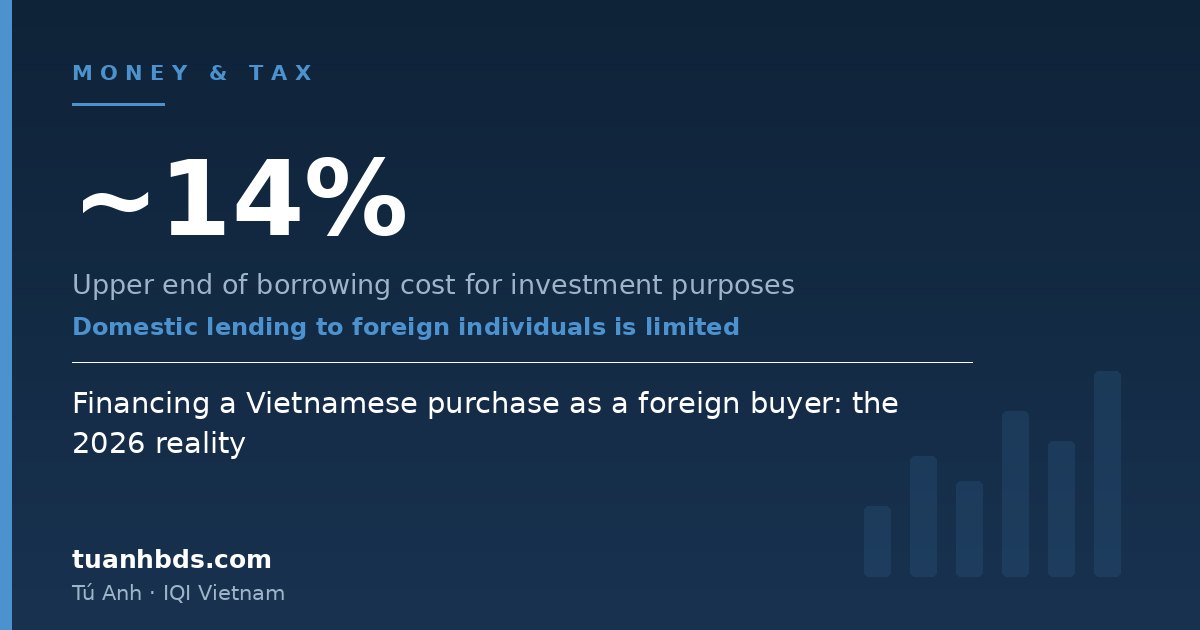
- Borrowing for investment purposes: up to around 14% per year depending on channel
Why the lending environment tightened
2026 introduced a constraint with no precedent in Vietnam: the State Bank required that real estate credit growth at each bank not exceed that bank's overall credit growth.
This is structural rather than cyclical. Property can no longer take a steadily rising share of system credit; it can only grow in step with the economy.
Three visible effects:
- Property lending separated from general lending in price. At BIDV the spread is close to 1.5 percentage points even at the shortest tenor.
- The term spread widened. A gap of four to five percentage points between short and long tenors reflects banks pricing long-dated property risk materially higher than other sectors.
- Allocation shifted by purpose. Credit is directed toward genuine owner-occupier demand and social housing; second and third purchases are constrained.
None of these favours a foreign investor seeking leverage.
What this means for your structure
If you are funding from offshore, the tight domestic credit environment is partly in your favour. You are competing for units against buyers whose purchasing power has been reduced. Absorption of newly launched apartments in Ho Chi Minh City fell to 45% in Q3 2026, down 24 percentage points in a single quarter. That is a negotiating position.
If you were relying on domestic leverage, rebuild the plan. Do not place a deposit on the assumption that financing will be arranged later.
"For a foreign individual with my residency and income profile, buying this unit in this project — will you lend, at what loan-to-value, at what rate after the promotional period, and over what tenor? Please confirm in writing."
A sales agent's confidence about bank lending is not a credit decision. The only answer worth planning around comes from the bank's own credit function.
The developer instalment schedule is financing
This is the financing most foreign buyers actually use, and it is rarely recognised as such.
Paying 30% now and the balance across construction milestones is a credit arrangement with the developer. The cost is embedded in the price, not quoted as a rate.
How to see what it costs: ask for the discount for early or full payment. The gap between the instalment price and the discounted price is the implied financing cost. Divide by the time saved and you have an approximate rate — often more competitive than domestic lending, sometimes not.
Two cautions on instalment schedules:
- Money paid earliest buys the least protection. A schedule weighted before foundation acceptance increases your exposure to completion risk.
- Promotional interest support ends. Where a developer subsidises interest for an initial period, ask what the monthly obligation becomes in month 25. That number, not the first-year number, is the one to test affordability against.
How to stress test
Three adjustments, applied together:
- Rate: post-promotional rate plus two percentage points
- Timing: completion and certificate issuance two to three years later than scheduled
- Exit: secondary pricing flat to modestly lower, consistent with Q3 2026 where secondary prices eased around 4% in the quarter
If the purchase still stands up under all three, the structure is sound. If it only works when rates stay low, the project is on time and prices rise, it is a bet — which may still be acceptable, but should be sized accordingly.
If you borrow or hold in a currency other than the dong while owning a dong-denominated asset, you are running a currency position alongside a property position. That is a second, separate risk with its own volatility. Size it deliberately rather than by accident.
Frequently asked questions
Can a foreign individual get a mortgage from a Vietnamese bank?
Access is limited and assessed case by case rather than offered as a standard product. Most foreign buyers fund the purchase from offshore sources or use the developer's instalment schedule. Treat any domestic financing as something to confirm in writing with a named bank before you rely on it.
What is happening to real estate credit in Vietnam in 2026?
For the first time, the State Bank of Vietnam required that real estate credit growth at each bank must not exceed that bank's overall credit growth. Banks are also pricing property lending above general lending, with BIDV charging close to 1.5 percentage points more even at the shortest tenor.
What rates apply to property borrowing in Vietnam?
Early-period promotional rates surveyed in 2026 were around 7.9 to 8.1% per year for owner-occupier borrowing, while borrowing for investment purposes could reach around 14% per year depending on the channel. Policy lending for social housing is far lower but is not available to foreign buyers.
Is a developer payment schedule a form of financing?
Effectively yes. Instalments spread over construction are a financing arrangement with the developer rather than a bank, and the interest is embedded in the price rather than quoted. Compare the discount for early full payment against the instalment plan to see what it costs.
How should I stress test the purchase?
Model it at the rate after any promotional period plus two percentage points, and assume the project completes later than scheduled. If the plan only works at promotional rates and on time, it is a bet rather than an investment.
Sources
- Credit policy 2026 and its effect on the housing market — www.thuvienbatdongsan.com
- Survey of home loan rates, 2026 — house.com.vn
- CBRE Vietnam — Ho Chi Minh City housing market, Q3 2026 — diendandoanhnghiep.vn
I am Tu Anh Nguyen (Ann), a real estate consultant at IQI Vietnam in Ho Chi Minh City. Before this I spent nearly eight years in Kuala Lumpur and moved home six times there — so I have been the foreigner trying to read someone else's property market, in someone else's language.
What that means in practice: I will put the awkward answers in writing. Remaining foreign quota in a specific building, the Department of Construction eligibility letter, the bank guarantee, the real walking distance to a metro station, what a unit like yours actually resold for. If a deal does not stand up, I would rather tell you before you wire a deposit.
Figures in this article come from published research and official documents, listed under Sources. This is general information for research purposes, not legal, tax or investment advice. Vietnamese property law is applied case by case — have a Vietnam-qualified lawyer review your specific transaction. Last updated: 26 October 2026.

Real estate consultant at IQI Vietnam, Ho Chi Minh City. Nearly eight years living and working in Kuala Lumpur before returning to Vietnam. Works in English and Vietnamese.
About Ann →