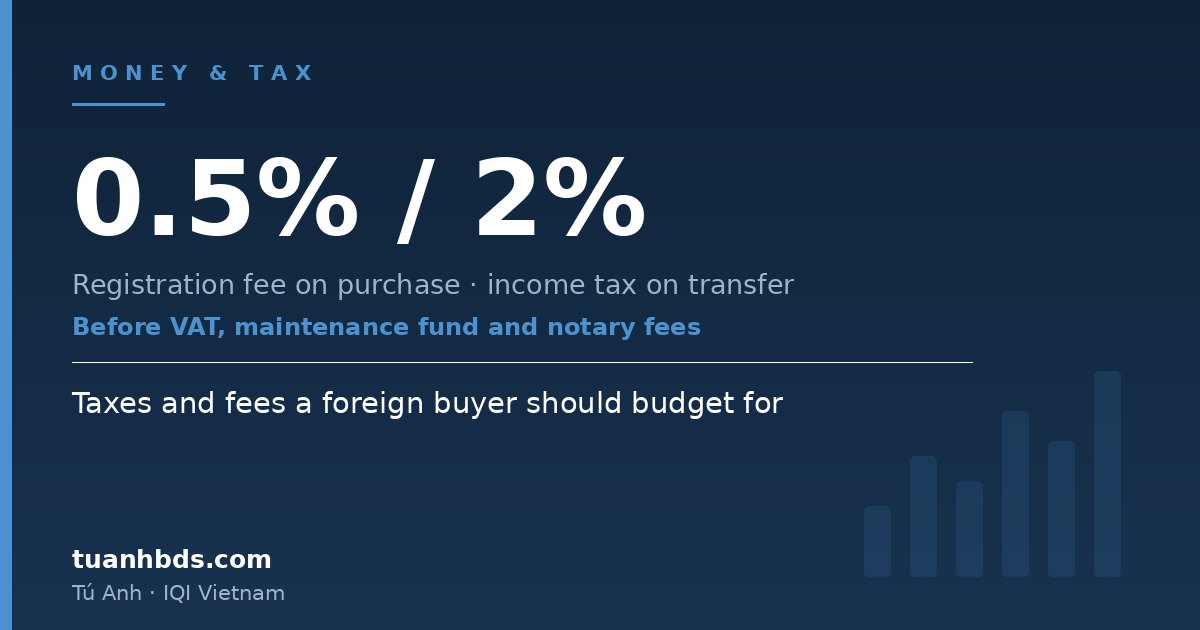
Taxes and fees a foreign buyer should budget for
Tu Anh Nguyen (Ann) · 26 October 2026 · 4 min read
The number on the brochure is not the number that leaves your account. In Vietnam the gap is wider than in most markets, because the quoted price conventionally excludes two significant items.
- Value added tax — normally excluded from the quoted price
- Maintenance fund: 2% of the unit value, paid once
- Registration fee: 0.5% of the assessed value
- Personal income tax on transfer: 2% of taxable transfer price, on exit
- Notary fees — sliding scale by contract value
- Certificate issuance and appraisal fees — set locally
Why report prices and contract prices differ
When CBRE publishes a primary price for Ho Chi Minh City — around VND 75 million per square metre of net usable area in Q3 2026 — that figure is quoted excluding VAT, the maintenance fund and discounts.
Developers quote on a similar basis. So two adjustments sit between the headline and the contract, before you have discussed anything else.
"What is the total amount I will transfer, from today until I hold the keys, including every tax and fee?"
One number. Ask for it in writing, broken down. A sales office that cannot produce that breakdown has not prepared for an informed buyer.
At purchase
Value added tax. Normally quoted separately from the headline price. Confirm the rate applied and the base in your contract rather than assuming — the treatment of the land value component affects the calculation.
Maintenance fund — 2%. A one-off payment of 2% of the unit value into the building's maintenance fund. This is not a developer charge; it funds the building's long-term maintenance and is managed under the building management framework. Budget for it in full at the appropriate stage.
Registration fee — 0.5%. Commonly borne by the buyer, calculated at 0.5% of the value used for assessment. On a VND 3 billion assessed value that is VND 15 million. Note the assessed value can differ from your contract price.
Notary fees. A sliding scale by contract value:
| Contract value | Fee |
|---|---|
| VND 1bn – 3bn | VND 1 million + 0.06% of the amount above VND 1bn |
| VND 3bn – 5bn | VND 2.2 million + 0.05% of the amount above VND 3bn |
| VND 5bn – 10bn | VND 3.2 million + 0.04% of the amount above VND 5bn |
| VND 10bn – 100bn | VND 5.2 million + 0.03% of the amount above VND 10bn |
Certificate issuance and appraisal fees. Set by the local authority, varying by area and by the complexity of the file.
Fit-out. Not a tax, but for a shell-handover unit it is a real cost that buyers routinely leave out of the budget and then fund awkwardly.
While you hold
Building management fees, payable monthly from handover — including while the unit is empty, which matters if certificate issuance or fit-out runs long.
Rental income tax, if you let the property. Rental income is taxable and should be declared. Keep rental contracts and tax receipts in the same file as your purchase documents; a clean income record supports the overall position.
On exit
Personal income tax on transfer — 2% of the taxable transfer price, applied to the seller. On a VND 3 billion taxable price that is VND 60 million. Exemptions exist in defined circumstances; whether any applies to you is a question for a tax adviser, not for a sales agent.
Purchase costs plus exit tax plus agency on sale typically consume a meaningful share of the first years of capital appreciation. In a market where Q3 2026 secondary prices eased around 4% in a single quarter, an investment case that only works on a short hold is an investment case that does not work.
Build the budget this way
- Headline price as quoted
- Plus VAT, at the rate stated in the contract
- Plus 2% maintenance fund
- Plus 0.5% registration fee on assessed value
- Plus notary, certificate and appraisal fees
- Plus fit-out, if handover is shell
- Plus ongoing management fees from handover
- Plus 2% transfer tax and agency costs modelled at exit
Then compare projects on step 7 totals, not on step 1. Two units with the same headline price can differ materially once handover specification and fee structures are included.
Figures above are expressed in Vietnamese dong because that is how they are assessed. If you are modelling in SGD, USD, MYR, KRW, JPY or RMB, build the model in dong first and convert at the end — converting line by line at different dates is how foreign buyers end up with a budget that does not reconcile.
Frequently asked questions
What tax does a seller pay on transferring property in Vietnam?
Personal income tax on transfer is applied at 2% of the taxable transfer price. On a VND 3 billion taxable price that is VND 60 million. Certain exemptions exist, so confirm your own position with a tax adviser.
What is the registration fee?
The registration fee, commonly paid by the buyer, is 0.5% of the value used for assessment. That assessed value can differ from the contract price depending on the asset.
Is the headline price from a developer the final price?
No. Quoted prices normally exclude value added tax and the 2% maintenance fund. Market reports also quote prices excluding VAT, maintenance fund and discounts, which is why report figures and contract figures differ.
What are notary fees?
Notary fees follow a sliding scale by contract value. For a contract between VND 1 billion and VND 3 billion, the fee is VND 1 million plus 0.06% of the amount above VND 1 billion. Higher bands apply above that, with an overall ceiling.
Are there ongoing costs after handover?
Yes. Building management fees run from handover, including while a unit sits empty. If the unit is let, rental income is taxable and should be declared.
Sources
- Taxes and fees on property transactions, 2026 overview (AZTAX) — aztax.com.vn
- Personal income tax on real estate transfer, 2026 (iGlobal) — iglobal.com.vn
- Transfer costs and procedures (ANT Legal) — antlegal.vn
- CBRE Vietnam — Q3 2026 pricing basis, excluding VAT and maintenance fund — vov.vn
I am Tu Anh Nguyen (Ann), a real estate consultant at IQI Vietnam in Ho Chi Minh City. Before this I spent nearly eight years in Kuala Lumpur and moved home six times there — so I have been the foreigner trying to read someone else's property market, in someone else's language.
What that means in practice: I will put the awkward answers in writing. Remaining foreign quota in a specific building, the Department of Construction eligibility letter, the bank guarantee, the real walking distance to a metro station, what a unit like yours actually resold for. If a deal does not stand up, I would rather tell you before you wire a deposit.
Figures in this article come from published research and official documents, listed under Sources. This is general information for research purposes, not legal, tax or investment advice. Vietnamese property law is applied case by case — have a Vietnam-qualified lawyer review your specific transaction. Last updated: 26 October 2026.

Real estate consultant at IQI Vietnam, Ho Chi Minh City. Nearly eight years living and working in Kuala Lumpur before returning to Vietnam. Works in English and Vietnamese.
About Ann →