How to verify an infrastructure claim in a sales brochure
Tu Anh Nguyen (Ann) · 26 October 2026 · 3 min read
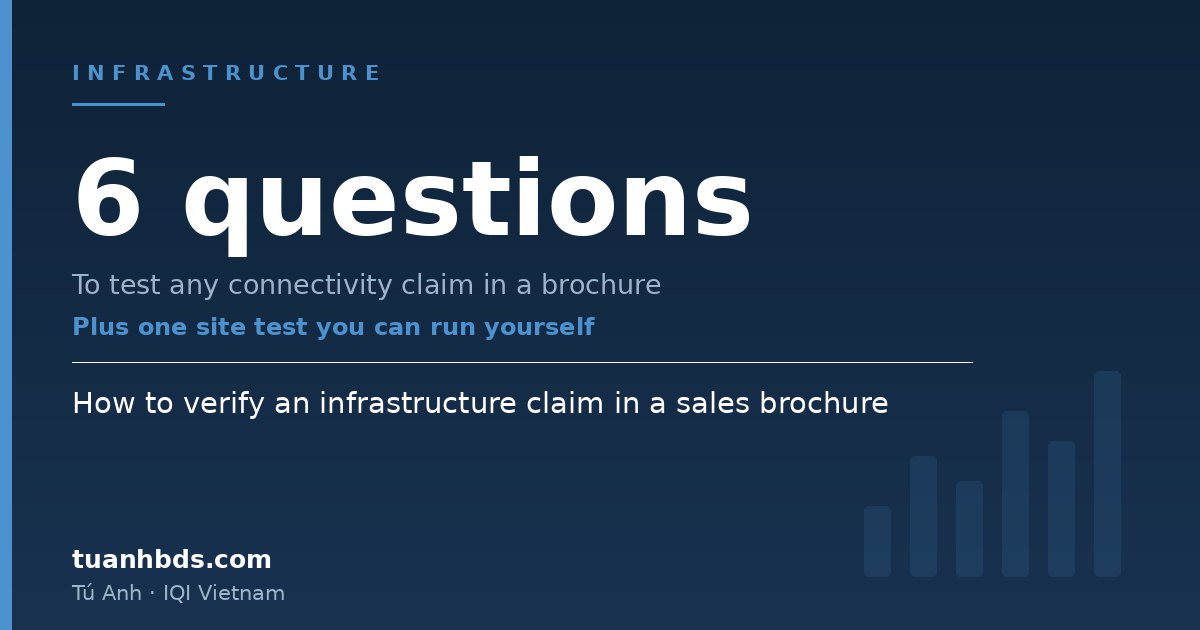
A short, practical article. Six questions, one site test. Use them on any project in Vietnam that sells itself on connectivity.
- Which specific project, and what is its current status?
- Walking time to the station entrance, or road distance to the interchange?
- Has the station or interchange position been formally fixed?
- Is the connecting road built, or still in planning?
- In which year does the described benefit arrive?
- Inside the designated boundary, or near it?
1. Which project, and what status
"Infrastructure is coming" is not a claim you can evaluate. Ask for the project by name and establish which of three categories it sits in:
- Operating — e.g. metro line 1, Ben Thanh – Suoi Tien
- Under construction — e.g. metro line 2, Ben Thanh – Thu Thiem
- Scheduled to start — e.g. metro line 6 phase 1
These are very different levels of certainty. Marketing material routinely lists all three under one heading.
2. Walking time, or road distance to the interchange
Two different measures for two different kinds of infrastructure, and neither is straight-line distance.
For metro: walking time from the building lobby to the station entrance. The planning radius for transit-oriented development is roughly a ten-minute walk.
For expressways and ring roads: road distance to the nearest interchange. A ring road only helps where you can get on and off it. A project two kilometres from the route but nine kilometres from an access point has gained very little.
3. Is the position fixed
Station and interchange locations shown in sales material are sometimes indicative positions from a design option rather than formally fixed points.
Ask: "Has this station position been formally fixed, and on the basis of which decision?" Indicative positions move, and when they do, the walking-time claim moves with them.
4. Is the connecting road built
This one is specific to Vietnam and catches many buyers.
A project may genuinely sit close to a new interchange — via a connecting road that exists only in a plan. Until that road is funded and built, the access does not exist.
Ask whether the connecting road has an investment decision, what stage it is at, and the expected completion year.
5. Which year
The question that is hardest to get answered, and the one that determines your holding period.
If the benefit arrives in 2032, then a buyer today is paying for an eight-year wait. That may still be a good decision. It is a different decision from the one implied by a brochure showing a completed station.
6. Inside the boundary, or near it
Specific to the financial-centre narrative. The designated zone covers around 898 hectares across Sai Gon ward (~146 ha), Ben Thanh ward (~20 ha), Thu Thiem (~563 ha) and river surface (~64 ha).
"Near the financial centre" and "inside the financial centre zone" are materially different statements. Ask which one applies.
Visit on a weekday at midday. Walk from the lobby to the station entrance or along the route to the nearest access point. Time it on your phone.
Then return at nine in the evening and count how many apartments in the building are dark. Occupancy tells you about the rental market and the resale market in a way no report will.
Two visits, perhaps ninety minutes in total, and more reliable than any brochure.
The meta-signal
When sales material says more about future public infrastructure than about the project's own legal status, build quality, management and price positioning, that imbalance is itself information.
Public infrastructure is free to talk about, costs the developer nothing, and is outside their control. Legal status, delivery record and build quality are the things they are accountable for — and the things a confident developer leads with.
In a market where Q3 2026 absorption of new launches reached only 45% and developers postponed more than 40% of planned launches, you have time to ask all six questions and wait for written answers. The pressure to decide quickly is a sales technique, not a market condition.
Frequently asked questions
What is the most common misleading claim?
Proximity stated as straight-line distance or in minutes without a stated mode of transport. The meaningful measures are walking time to a station entrance and road distance to an expressway interchange.
How do I check whether a station location is final?
Ask whether the station position has been formally fixed and on the basis of which decision, rather than being an indicative position in a design option. Indicative positions move.
Does "inside the financial centre zone" mean anything?
It can. The international financial centre boundary covers around 898 hectares across Sai Gon ward, Ben Thanh ward and Thu Thiem. Ask whether the unit is inside that boundary or merely near it, and in which year the described benefit arrives.
What is the single best test on a site visit?
Walk the route yourself at midday and time it. If the walk to the station exceeds about ten minutes, or lacks continuous footpath and shade, residents will use motorbikes regardless of the masterplan.
Is a brochure that emphasises infrastructure a bad sign?
Not in itself. It becomes a signal when the material says more about future public infrastructure than about the project's own legal status, build quality, management and pricing.
Sources
- HCMC People's Council — eastern area infrastructure and metro lines — hdnd.hochiminhcity.gov.vn
- Ho Chi Minh City authorities — international financial centre boundary — ttbc-hcm.gov.vn
- CBRE Vietnam — market conditions, Q3 2026 — diendandoanhnghiep.vn
I am Tu Anh Nguyen (Ann), a real estate consultant at IQI Vietnam in Ho Chi Minh City. Before this I spent nearly eight years in Kuala Lumpur and moved home six times there — so I have been the foreigner trying to read someone else's property market, in someone else's language.
What that means in practice: I will put the awkward answers in writing. Remaining foreign quota in a specific building, the Department of Construction eligibility letter, the bank guarantee, the real walking distance to a metro station, what a unit like yours actually resold for. If a deal does not stand up, I would rather tell you before you wire a deposit.
Figures in this article come from published research and official documents, listed under Sources. This is general information for research purposes, not legal, tax or investment advice. Vietnamese property law is applied case by case — have a Vietnam-qualified lawyer review your specific transaction. Last updated: 26 October 2026.

Real estate consultant at IQI Vietnam, Ho Chi Minh City. Nearly eight years living and working in Kuala Lumpur before returning to Vietnam. Works in English and Vietnamese.
About Ann →