Vietnam's metro network and TOD: which lines actually matter to a buyer
Tu Anh Nguyen (Ann) · 26 October 2026 · 3 min read
"Near the metro" is the most used phrase in Vietnamese property marketing and one of the least defined. This article gives you the network picture and a test you can apply on a site visit.
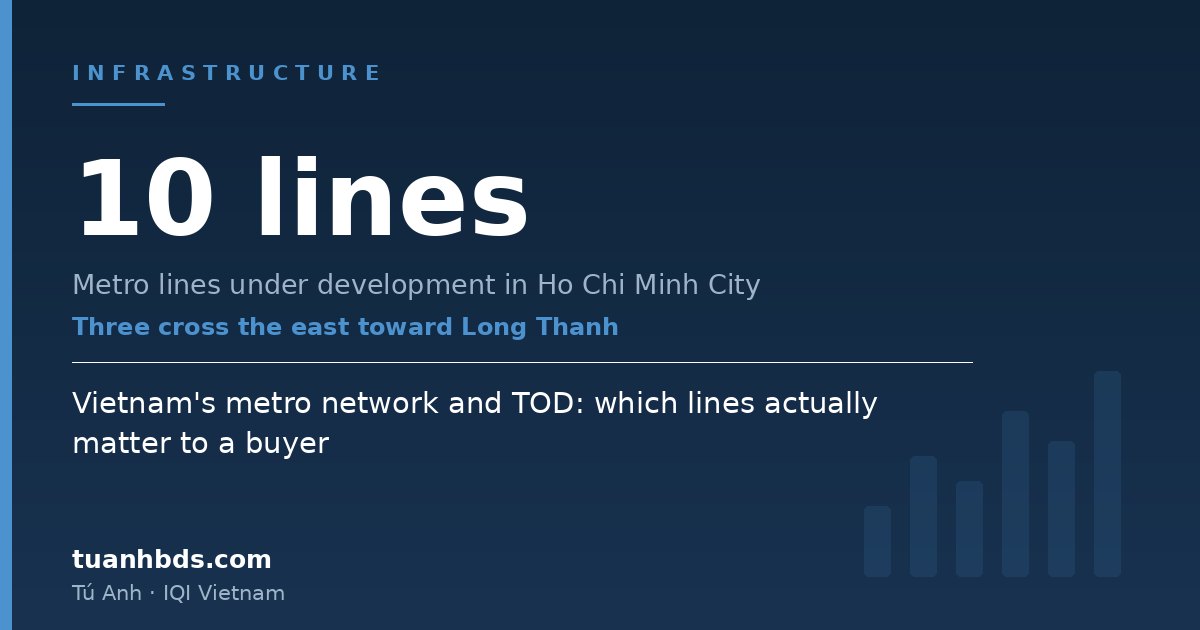
- Ho Chi Minh City is developing ten metro lines: two under investment, eight in preparation
- Line 1 Ben Thanh – Suoi Tien: operating
- Line 2 Ben Thanh – Thu Thiem: construction started, investment above VND 46,000 billion
- Thu Thiem – Long Thanh and line 6 phase 1: scheduled to begin September and December 2026
- Three lines cross the eastern area toward Long Thanh airport
Why metro matters more than roads, for a resident
For someone living in the property, a metro line changes daily life more than a ring road does.
Metro carries commuters at predictable journey times, unaffected by congestion. A ring road primarily serves regional and freight movement — it improves connectivity at the metropolitan scale but rarely changes an individual household's morning commute.
That is why proximity to metro justifies a price premium in a way that proximity to an expressway usually does not. Provided the proximity is real.
The lines are not interchangeable
Each of the three eastern lines serves a different function, and the distinction affects what kind of tenant or buyer your unit attracts.
Ben Thanh – Thu Thiem connects the established centre to the new urban area. This is a daily commuter line between the two halves of the planned financial district. For an owner-occupier, it has the most direct effect.
Thu Thiem – Long Thanh connects to the international airport gateway. Its users are air passengers, international professionals and inter-regional travellers — not people commuting to a city-centre office. For property, it matters more to the expatriate rental segment and to the strategic positioning of Thu Thiem than to an ordinary household.
Line 6 phase 1 (Tan Son Nhat – Phu Huu) links the existing airport to the eastern area, adding a lateral connection to the network.
When an agent says "close to the metro", ask: "Which line, and who does that line serve?" An airport line and a commuter line produce different tenant pools and different resale audiences. They are not substitutes.
What TOD actually requires
Transit-oriented development concentrates residential density, offices and retail within a walkable radius of a station, so that most trips begin on foot.
The working radius used in planning is roughly a ten-minute walk. Beyond it, residents revert to motorbikes and the model stops functioning.
Four tests for whether a development is genuinely TOD rather than simply adjacent to a line:
- Walking time from lobby to station entrance — measured, not estimated, and not straight-line distance
- Mixed use within the area, so the station carries traffic in both directions through the day, rather than emptying in the morning and refilling at night
- Pedestrian design — continuous footpaths, shade and cover, safe crossings. In the Ho Chi Minh City climate, shade determines whether people walk at all
- Station location formally fixed, not indicative in a design option
Visit at midday. Walk from the lobby to the planned station entrance. Time it. If it exceeds ten minutes, or the route lacks continuous footpath and shade, residents will ride — regardless of what the masterplan says, and regardless of whether the project sits inside a designated TOD boundary.
Where the price premium already sits
Property prices respond to a metro line across four phases: route announcement, approval and groundbreaking, construction, and operation. The largest increases typically occur in the first two.
The eastern lines are now in phase two and early phase three. Most of the expectation is therefore already reflected in asking prices, while the usable benefit is still years away.
That is not an argument against buying near a line. It is an argument against paying a large premium for a benefit the market has already priced, and against treating "future metro" as the primary reason to buy.
The direction of travel is real: Savills notes that Grade A supply for 2026–2029 is concentrating in areas served by strategic infrastructure, with integrated live–work–retail developments increasingly the preferred format. Buy into that trend on the merits of the specific unit, not on the strength of a line on a map.
Frequently asked questions
How many metro lines is Ho Chi Minh City developing?
Ten lines in total: two under investment and eight in preparation. Three of them cross the eastern area and connect toward Long Thanh airport, and all three started or were scheduled to start construction during 2026.
Which lines are furthest advanced?
Metro line 1 from Ben Thanh to Suoi Tien is operating. Metro line 2 from Ben Thanh to Thu Thiem has started construction with investment above VND 46,000 billion. The Thu Thiem to Long Thanh line and metro line 6 phase 1 were scheduled to begin in September and December 2026.
What is TOD and what radius does it use?
Transit-oriented development concentrates density and mixed uses around a station. The working radius is roughly a ten-minute walk. Beyond that, most residents will not walk to the station and the benefit falls away quickly.
Does a metro line raise property prices?
It raises the usable value of a location by making journey times predictable. But most of the expected gain is typically priced in during the announcement and groundbreaking phases, well before trains run.
How do I check a "near the metro" claim?
Ask which line, which station, the walking time from the lobby to the station entrance, whether the route crosses a major road, and whether the station location has been formally fixed rather than being indicative.
Sources
- HCMC People's Council — metro lines and eastern area infrastructure — hdnd.hochiminhcity.gov.vn
- Overview of eastern Ho Chi Minh City infrastructure, 2026 — gamudalandvietnam.vn
- Savills Vietnam — integrated urban development and Grade A supply — tienphong.vn
I am Tu Anh Nguyen (Ann), a real estate consultant at IQI Vietnam in Ho Chi Minh City. Before this I spent nearly eight years in Kuala Lumpur and moved home six times there — so I have been the foreigner trying to read someone else's property market, in someone else's language.
What that means in practice: I will put the awkward answers in writing. Remaining foreign quota in a specific building, the Department of Construction eligibility letter, the bank guarantee, the real walking distance to a metro station, what a unit like yours actually resold for. If a deal does not stand up, I would rather tell you before you wire a deposit.
Figures in this article come from published research and official documents, listed under Sources. This is general information for research purposes, not legal, tax or investment advice. Vietnamese property law is applied case by case — have a Vietnam-qualified lawyer review your specific transaction. Last updated: 26 October 2026.

Real estate consultant at IQI Vietnam, Ho Chi Minh City. Nearly eight years living and working in Kuala Lumpur before returning to Vietnam. Works in English and Vietnamese.
About Ann →