Infrastructure timelines: the gap between groundbreaking and trains running
Tu Anh Nguyen (Ann) · 26 October 2026 · 3 min read
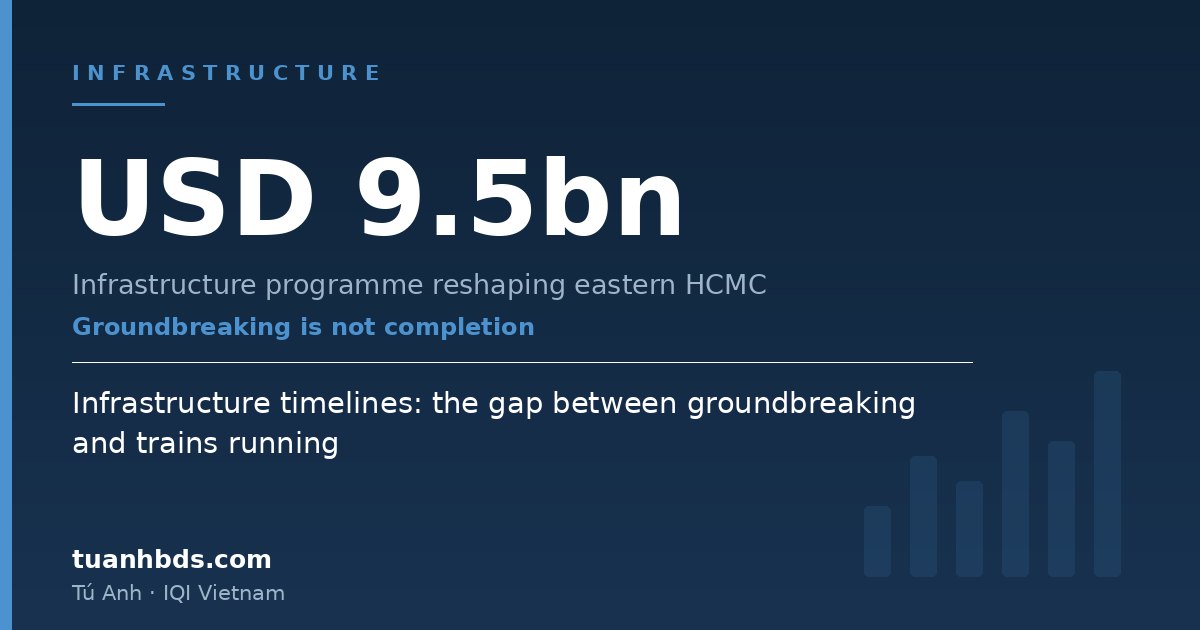
Vietnam is building a great deal of infrastructure, and that is a genuine reason international capital is interested. It is also the most frequently abused element of a sales pitch. The difference lies in distinguishing status from aspiration, and in modelling delay honestly.
- The eastern area receives more than 70% of the city's total infrastructure investment
- Programme value: more than USD 9.5 billion
- Ring Road 3 and the widened HCMC – Long Thanh expressway: due late 2026 – early 2027
- About 14 km of elevated viaduct on Ring Road 3 links Tan Van with the HLD interchange
Status table
| Project | Status | Expected |
|---|---|---|
| Metro line 1, Ben Thanh – Suoi Tien | Operating | — |
| Metro line 2, Ben Thanh – Thu Thiem | Under construction | — |
| Thu Thiem – Long Thanh metro | Construction starting 2026 | — |
| Metro line 6 phase 1 | Scheduled start | December 2026 |
| An Phu interchange | Being completed | — |
| Ring Road 3 | Being completed | late 2026 – early 2027 |
| HCMC – Long Thanh expressway widening | Under way | late 2026 – early 2027 |
| Thu Thiem administrative centre | Under construction | operational Sept 2028 |
Three categories appear in that table — operating, under construction, scheduled to start — and they are not equivalent. A sales presentation that lists them together under "infrastructure" has already blurred the distinction that matters most.
Interchanges, not routes
The most common geographic error in Vietnamese property marketing: treating proximity to a route as proximity to its benefit.
A ring road only helps you where you can get on and off it. The HLD interchange connects the Ho Chi Minh City – Long Thanh – Dau Giay expressway with Ring Road 3, the Nhon Trach bridge approach and the Cat Lai – Phu Huu inter-port road. Land near that node has genuinely improved access. Land two kilometres from the route but nine kilometres from the nearest interchange has not.
"How far is this project from the nearest interchange by road, and has the connecting road been built or is it still in planning?"
Not distance to the route. Distance to the access point, and the status of the road that gets you there.
Who a ring road actually serves
Ring Road 3 is designed primarily for inter-regional and freight movement. It improves metropolitan connectivity and supports logistics and industrial property.
For a household commuting into the central area each morning, its effect is smaller than a metro line's — even though the ring road sounds more impressive and is further advanced.
Match the infrastructure to your use case. If you are buying to live and work centrally, metro proximity is worth more. If you are buying industrial or logistics exposure, the ring road is the relevant asset.
Infrastructure does not override the cost of money
This is the part of the story that 2026 has demonstrated clearly.
The east is absorbing more than 70% of the city's infrastructure investment. Over the same period, across Ho Chi Minh City:
- Absorption of newly launched apartments: 45%, down 24 percentage points in the quarter
- Secondary prices: easing about 4% in the quarter
- New supply: 3,267 units, down 53% year on year
A buyer who cannot borrow, or who borrows at an investment-purpose rate reaching around 14% a year, does not transact because another metro line broke ground.
Infrastructure operates on a five-to-ten-year horizon. Interest rates and liquidity operate on a horizon of quarters. Mixing the two timeframes inside one decision is the most common analytical error in this market.
How to stress test
Three adjustments, applied simultaneously:
- Delay: assume completion two to three years later than published
- Rates: model post-promotional borrowing cost plus two percentage points
- Exit: assume secondary pricing flat to modestly lower, consistent with Q3 2026
If the case survives all three, the asset stands on its own merits. If it requires on-time delivery, cheap money and rising prices simultaneously, it is a bet on three correlated outcomes — which is considerably riskier than it appears when each is discussed separately.
Metro line 1 is the nearest observable example of the gap between announced and actual timelines in Ho Chi Minh City. Anyone selling you a benefit from a line that broke ground in 2026 should be able to discuss that precedent without flinching. If they cannot, you are talking to a salesperson rather than an adviser.
Frequently asked questions
How much infrastructure investment is going into eastern Ho Chi Minh City?
The eastern area receives more than 70% of the city's total infrastructure investment, with a programme of projects worth more than USD 9.5 billion restructuring regional connectivity.
When is Ring Road 3 due to complete?
Ring Road 3 and the widening of the Ho Chi Minh City – Long Thanh expressway are expected to complete in late 2026 and early 2027. Around 14 kilometres of elevated viaduct on Ring Road 3 links Tan Van with the HLD interchange.
What is the HLD interchange?
It connects the Ho Chi Minh City – Long Thanh – Dau Giay expressway with Ring Road 3, the Nhon Trach bridge approach road and the Cat Lai – Phu Huu inter-port road. Proximity to an interchange matters far more than proximity to the route itself.
Does completed infrastructure guarantee higher prices?
No. In Q3 2026, despite heavy infrastructure investment in the east, absorption of newly launched apartments across Ho Chi Minh City was only 45% and secondary prices eased about 4%. Infrastructure improves long-term value; it does not offset borrowing costs in the short term.
How should I allow for delay?
Re-run the investment case assuming the infrastructure arrives two to three years late. If it still works, the decision rests on the asset. If it only works on schedule, it is a bet on delivery timing.
Sources
- HCMC People's Council — USD 9.5 billion infrastructure programme for the eastern area — hdnd.hochiminhcity.gov.vn
- Overview of eastern Ho Chi Minh City infrastructure, 2026 — gamudalandvietnam.vn
- CBRE Vietnam — absorption and pricing, Q3 2026 — cafeland.vn
I am Tu Anh Nguyen (Ann), a real estate consultant at IQI Vietnam in Ho Chi Minh City. Before this I spent nearly eight years in Kuala Lumpur and moved home six times there — so I have been the foreigner trying to read someone else's property market, in someone else's language.
What that means in practice: I will put the awkward answers in writing. Remaining foreign quota in a specific building, the Department of Construction eligibility letter, the bank guarantee, the real walking distance to a metro station, what a unit like yours actually resold for. If a deal does not stand up, I would rather tell you before you wire a deposit.
Figures in this article come from published research and official documents, listed under Sources. This is general information for research purposes, not legal, tax or investment advice. Vietnamese property law is applied case by case — have a Vietnam-qualified lawyer review your specific transaction. Last updated: 26 October 2026.

Real estate consultant at IQI Vietnam, Ho Chi Minh City. Nearly eight years living and working in Kuala Lumpur before returning to Vietnam. Works in English and Vietnamese.
About Ann →