Married to a Vietnamese citizen? Your ownership rights are different
Tu Anh Nguyen (Ann) · 26 October 2026 · 3 min read
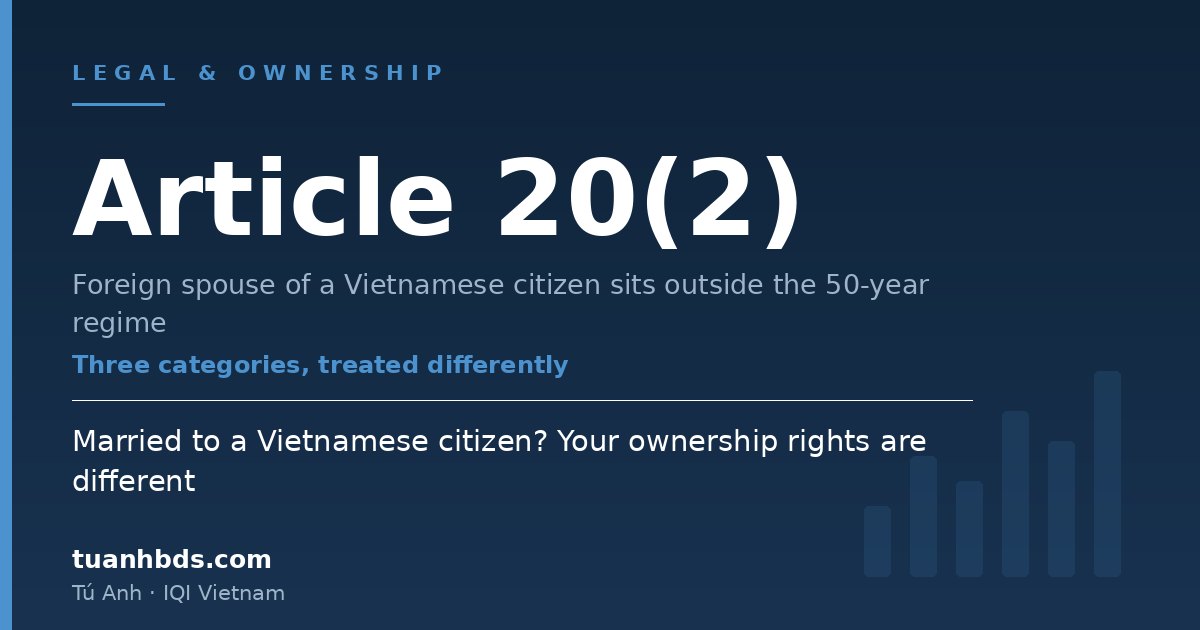
If you are a foreign national married to a Vietnamese citizen, or to an overseas Vietnamese, you may be operating under a materially better set of rules than you have been told — and most international summaries do not mention it.
Housing Law 2023, Article 20(2) distinguishes three positions:
- Foreign individual, general — ownership tied to the transaction, no more than 50 years from certificate issuance, renewable once for up to 50 more. The term is stated on the certificate.
- Foreign individual married to a Vietnamese citizen living in Vietnam — owns housing with the rights of a Vietnamese citizen. This sits outside the 50-year clause.
- Foreign individual married to an overseas Vietnamese permitted to enter Vietnam — rights equivalent to those of an overseas Vietnamese.
Why this matters more than it sounds
The 50-year term is the structural feature that most affects a foreign buyer's exit economics. Your eventual buyer purchases the remaining term plus an expectation of renewal, and the discount starts applying long before expiry.
Remove the term limit and much of that friction goes with it. You are no longer the seller of a depleting asset competing against domestic buyers holding stable long-term title; you are closer to being in the same position they are.
For couples planning to live in Vietnam long term, that difference compounds across a holding period and shows up most clearly at the moment of sale.
Article 21(2)(a) places the same spouse group under owner obligations equivalent to those of a Vietnamese citizen. This is not a selective upgrade. It is a change of category, with both sides attached.
The three categories are genuinely different
A common error is to treat "married to a Vietnamese" and "married to an overseas Vietnamese" as the same situation. The law does not.
| Your situation | Position under Article 20(2) |
|---|---|
| Foreign individual, no Vietnamese spouse | Up to 50 years, renewable once |
| Married to a Vietnamese citizen living in Vietnam | Rights of a Vietnamese citizen |
| Married to an overseas Vietnamese permitted to enter Vietnam | Rights equivalent to an overseas Vietnamese |
If you fall into the second or third category, the first thing to establish is which one, because the answer determines everything downstream.
What this does not automatically settle
Three things that still require checking:
The quota questions are separate. The 30% cap per apartment block and the 250-house ceiling per ward-sized area are set by Decree 95/2024/ND-CP and govern acquisitions by foreign organisations and individuals. How your particular status interacts with those caps is a question for a lawyer, not an inference from this article.
Documentation of the marriage. The provision operates on a legal relationship, which means the marriage must be recognised and evidenced appropriately in Vietnam. Get this confirmed before structuring a purchase around it.
The residence condition. The text refers to a Vietnamese citizen living in Vietnam. Where the couple actually resides is not incidental to the provision.
"Under Article 20(2) of Housing Law 2023, which category applies to me given my spouse's status and our residence, what ownership term will appear on the certificate, and what documentation is required to establish it before we sign?"
That question is specific enough to get a usable answer. "Can I buy property in Vietnam?" is not.
A practical note for mixed-nationality couples
This is common among Korean, Japanese, Chinese, Singaporean and Malaysian readers who have settled in Vietnam, and the planning implication is straightforward:
Establish the status before you choose the property, not after. The category you fall into affects which projects make sense, how you should think about holding period, and what a reasonable entry price looks like — because it changes who you will eventually sell to.
Buyers who confirm this late often find they have optimised around a constraint that never applied to them.
This article summarises published provisions so you know which question to ask. Vietnamese housing law is applied case by case, and marital and residence status add real complexity. Have a Vietnam-qualified lawyer confirm your position before you rely on it in a transaction.
Frequently asked questions
Does the 50-year limit apply to a foreign spouse of a Vietnamese citizen?
Article 20(2) of Housing Law 2023 provides that a foreign individual married to a Vietnamese citizen living in Vietnam owns housing with the rights of a Vietnamese citizen. That provision sits outside the 50-year clause that applies to foreign individuals generally. Confirm your own position with a Vietnam-qualified lawyer.
What is the general rule for foreign individuals?
Under Article 20(2)(c), ownership is tied to the transaction, for no more than 50 years from the date the certificate is issued, with one renewal of up to 50 years. The term must be stated on the certificate.
What about a foreign spouse of an overseas Vietnamese?
A foreign individual married to an overseas Vietnamese who is permitted to enter Vietnam is given rights equivalent to those of an overseas Vietnamese. The two spouse categories are therefore treated differently from each other.
Do the obligations change too?
Yes. Article 21(2)(a) places the same spouse group under owner obligations equivalent to those of a Vietnamese citizen, so the position is symmetrical rather than purely advantageous.
Does this remove the quota limits?
That is a separate question from the ownership term and should be confirmed for your circumstances. The 30% per-block cap and the 250-house ceiling per ward-sized area are set out in Decree 95/2024/ND-CP and govern acquisitions by foreign organisations and individuals.
Sources
- Housing Law 2023, Article 20(2) — ownership by a foreign spouse (Thu Vien Phap Luat) — thuvienphapluat.vn
- Analysis — foreign spouse and long-term housing ownership (Luat Minh Khue) — luatminhkhue.vn
- Decree 95/2024/ND-CP guiding the Housing Law — thuvienphapluat.vn
I am Tu Anh Nguyen (Ann), a real estate consultant at IQI Vietnam in Ho Chi Minh City. Before this I spent nearly eight years in Kuala Lumpur and moved home six times there — so I have been the foreigner trying to read someone else's property market, in someone else's language.
What that means in practice: I will put the awkward answers in writing. Remaining foreign quota in a specific building, the Department of Construction eligibility letter, the bank guarantee, the real walking distance to a metro station, what a unit like yours actually resold for. If a deal does not stand up, I would rather tell you before you wire a deposit.
Figures in this article come from published research and official documents, listed under Sources. This is general information for research purposes, not legal, tax or investment advice. Vietnamese property law is applied case by case — have a Vietnam-qualified lawyer review your specific transaction. Last updated: 26 October 2026.

Real estate consultant at IQI Vietnam, Ho Chi Minh City. Nearly eight years living and working in Kuala Lumpur before returning to Vietnam. Works in English and Vietnamese.
About Ann →